- 2,027,840 Acre Feet
- 65 Miles of Shoreline
- Surface Area 12,250 acres
- 270 feet deep
- Oneill Forebay Water Heights full=222.60 ft (<219ft is too shallow to boat) Water data
- San Luis Reservoir full=543 ft Water data
San Luis Reservoir is one of California’s largest reservoirs and a critical component of the state’s water supply system. In fact, with a capacity of more than 2 million acre-feet (AF), it is the largest off-stream storage facility in the world.
I always dreamed of knowing a body of water so well that I could catch fish in it almost at will—in any weather, under any conditions. I figured that might happen later in life, when I retired to some little lakefront or riverfront cabin and lived out my own version of Walden Pond.
But one thing I’ve learned from fishing all over the world is that sometimes we overlook the best fishing of all because it’s right under our noses.
Some of my most memorable fishing has happened almost by accident: catching an enormous bass in my backyard lake, Calero Reservoir; casting to 20-pound mudding carp on the flats of the Perc Ponds near my office; or catching a 12-inch trout on an indicator and nymph in the creek behind Leland High School.
Those experiences remind me why I started fishing in the first place. It was fun. It was close. It was easy. And it was cheap.
So maybe I don’t need that cabin on some distant lake.
Maybe my Walden Pond has been sitting an hour from my house all along.
San Luis Reservoir
It’s time for me to understand San Luis Reservoir. Really understand it.
Next to the California Delta, I think it’s the best world-class fishing water within an hour of my home. These pages are dedicated to one goal: cracking the mystery of San Luis Reservoir stripers.
My relationship with San Luis goes back more than half a century.
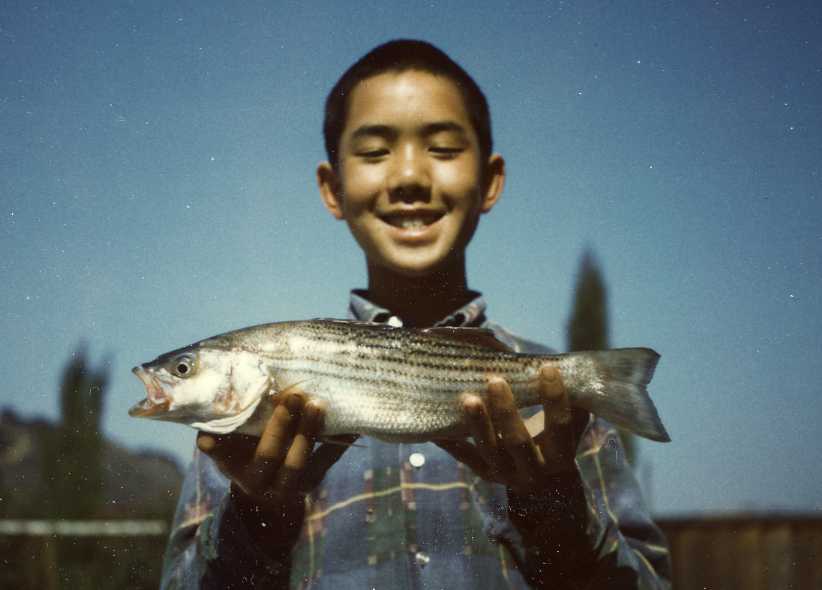
I started fishing there sometime around 1970, when I was about 13 years old. My dad would take me to the lake and teach me how to catch striped bass from shore with anchovies. He also taught me how to dispatch, clean and dress our stripers properly so my mother wouldn’t complain about the fish we brought home. What I now recognize as principles similar to ikejime—quickly and humanely dispatching a fish to preserve the quality of the meat—was simply how my dad believed fish should be handled.
My dad was a meat fisherman.
And because he was obsessed with bringing home fish, I became pretty handy with a fillet knife at 13 years old. Maybe all that early practice with a blade contributed a little to my eventual profession as a dentist. Back then, though, it wasn’t about biology, conservation, electronics, fly lines, water movement or understanding why the fish were where they were. It was about catching fish. Lots of them. San Luis was the meat locker.
More than 50 years later, I’ve come back to the same reservoir with a completely different curiosity. Today I’m less interested in simply catching stripers than in understanding them. Why are they here today and gone tomorrow? How do water temperature, current, pumping, baitfish, wind, season and reservoir level affect their movements? Why does one shoreline suddenly come alive while another that looks perfect holds nothing? Where do the big fish go? And what exactly makes San Luis such an extraordinary striper fishery?
There’s another part of the story, too—the biology and politics of the water itself.
San Luis Reservoir is a fascinating contradiction. It is an enormous artificial reservoir created as part of California’s effort to capture, store and move water. The striped bass that made it famous aren’t native to California either. Yet together, this man-made body of water and a transplanted gamefish have created something remarkable: a world-class fishery in the middle of the dry hills of Central California. And its future is tied directly to the complicated politics of California water.
So that’s what this blog is about.
Not simply how to catch stripers at San Luis Reservoir, but how the entire system works—the fish, the forage, the water, the pumps, the seasons, the weather, the history and the politics. I’ve been fishing San Luis since I was 13. Now I want to figure it out.
.

The Lake-Man Made Striper Habitat dedicated by John F Kennedy
JFK gave this speech at the groundbreaking of the project actually detonating an explosive at the projected water level of the finished dam on August 18th 1962. The dam project was completed in 1967 but President John Kennedy never saw the completed project as he was assassinated in Texas a year later on November 22, 1963. …how we set things in motion not knowing what the future will bring.
History and Biology of Striped Bass
Striped bass have been prized in America for more than four centuries.
Captain John Smith wrote in 1614 that striped bass were “a most sweet and wholesome fish as ever I did eat.” Twenty years later, William Wood wrote in New England’s Prospect that the striped bass was “one of the best fishes in the Country . . . a delicate, fine, fat fish.” Striped bass were also part of the food supply of the earliest New England colonies and have been associated with the American table since colonial times.
The striped bass, Morone saxatilis, is native to the Atlantic Coast of North America. By the 1600s, striped bass were already an important food fish in New England and the Chesapeake region. Early accounts describe an abundance that is difficult to imagine today. John Smith famously wrote of fish being so plentiful that it seemed possible to cross the water “dryshod” on their backs.
Stripers are remarkably long-lived predators. They can survive for several decades and, under exceptional circumstances, exceed 100 pounds and approach five feet in length. A 50-pound striper today is an extraordinary trophy and, for most fishermen, truly a once-in-a-lifetime fish.
How 435 Fish Changed California Forever
Here’s the amazing part of the California striper story:
The entire California striped bass fishery began with just 435 fish.
Striped bass were introduced to California on only two occasions—135 young fish in 1879 and another 300 in 1882. The original fish were transported across the country by train from New Jersey’s Navesink River and released into the Carquinez Strait, where the Sacramento–San Joaquin Delta meets San Francisco Bay. And they absolutely flourished.
Within months, reports of striped bass began appearing outside the immediate planting area. Only four years after the original introduction, in October 1883, a fisherman reportedly caught a 16-pound striped bass in the Sacramento River. Think about that for a second. A few hundred non-native fish were put into San Francisco Bay, and within a remarkably short period they had established a reproducing population throughout a huge aquatic ecosystem. Imagine what the California Department of Fish and Wildlife would say today if somebody proposed dumping a few hundred East Coast predators into San Francisco Bay!
The population exploded. Between 1889 and 1892, the commercial harvest of striped bass reportedly increased by roughly 250 percent. Historical accounts describe catches that sound almost unbelievable by today’s standards. One San Francisco Bay party boat was reported to have landed approximately 1,500 striped bass in a single trip in 1894, with many of the fish weighing between seven and fourteen pounds. Striped bass became so successful that California developed a substantial commercial fishery for them. That continued until 1935, when sport fishermen successfully pushed to end commercial harvest and reserve striped bass primarily as a recreational gamefish.
The Fish Kept Moving
Historical observations also provide an interesting picture of where California’s early striped bass populations concentrated. Large schools of spawning stripers were repeatedly observed in the San Joaquin River during the late nineteenth and early twentieth centuries. At the same time, commercial salmon fishermen working the Sacramento River apparently reported relatively few striped bass. That distribution eventually changed. Today striped bass are common throughout much of the Sacramento–San Joaquin system, and large schools can be found throughout the Delta and its connected waterways.
They didn’t stop there.
Striped bass eventually established populations along much of the Pacific Coast, ranging north into Oregon—including the Umpqua River—and south along California’s coastline. It’s an extraordinary ecological experiment that nobody could duplicate today:
A few hundred fish released more than 140 years ago permanently changed a major West Coast fishery.
Biology of a Striper
Striped bass are built to migrate. They move between bays, estuaries, rivers and—in landlocked populations—reservoirs and tributaries, responding to temperature, current, food and spawning conditions.
They can also live a surprisingly long time. A 36-inch, 20-pound striper may already have survived many years of predators, droughts, floods, changing food supplies and fishing pressure. Like trees, fish leave clues to their age. Biologists can estimate a striped bass’s age by examining growth rings, or annuli, on its scales and other hard structures. Their reproductive strategy helps explain how those original 435 California fish were able to establish themselves so quickly. Striped bass generally migrate into rivers and moving freshwater during the spring to spawn. Unlike salmon, they don’t build nests. Their eggs are released into the water column. And those eggs need moving water.
After fertilization, striped bass eggs remain suspended as they drift downstream. Depending on water temperature, development takes roughly two days before they hatch. If the eggs settle to the bottom too quickly, survival can decline dramatically. That little piece of biology—current keeps the eggs alive—becomes extremely important when trying to understand striped bass populations in California. Females are tremendously productive. A mature female can produce hundreds of thousands of eggs, while larger females can produce well over a million during a spawning season. That reproductive capacity is one reason striped bass were able to expand so rapidly after their introduction. It also helps explain something fundamental about the fish I’ve spent so many years chasing: Stripers are survivors.
They have endured enormous changes to California’s aquatic environment—dams, pumps, diversions, droughts, floods, invasive species, changing food webs and more than a century of intense fishing pressure. And yet descendants of those 435 East Coast fish are still swimming through the Delta, San Francisco Bay and San Luis Reservoir today.
Understanding how they managed to do that is an important part of understanding how to catch them.
San Luis Reservoir Dam Raising (edit 10/2023)
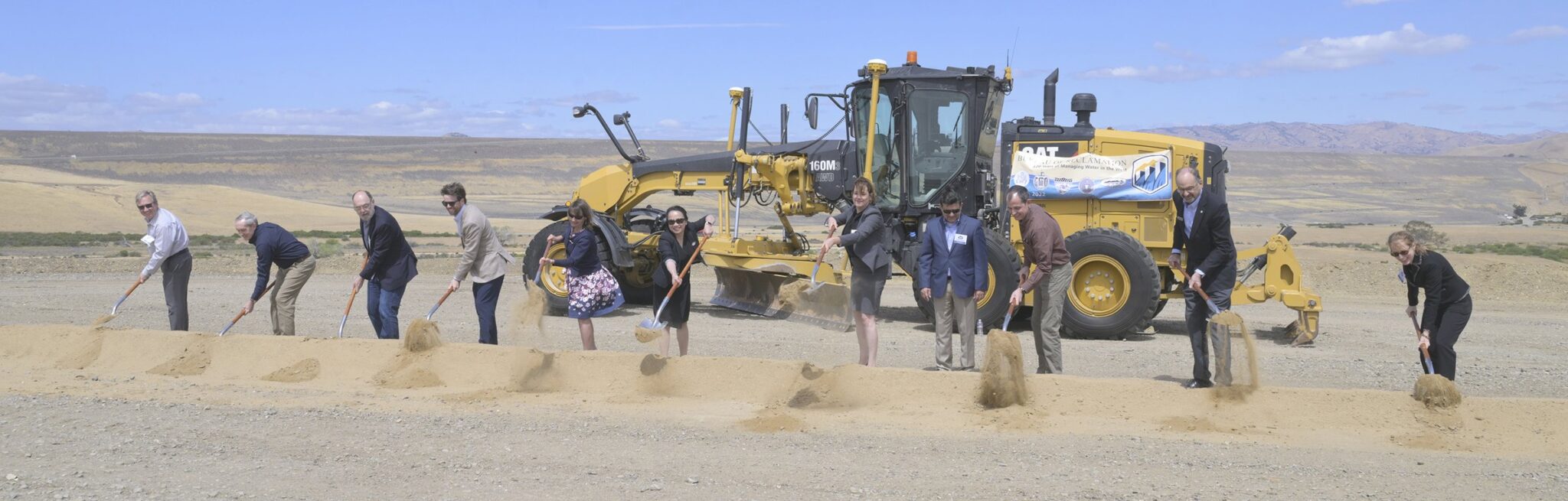
June 17, 2022 on Kennedy Hill where Groundbreaking took place in 1962
Raising B.F. Sisk Dam — A Bigger San Luis Reservoir
San Luis Reservoir is undergoing the biggest physical transformation in its history.
Construction began in June 2022 on a massive project to strengthen B.F. Sisk Dam against earthquakes. At the same time, the federal government and the San Luis & Delta-Mendota Water Authority are taking advantage of that work to pursue something California doesn’t do very often anymore:
Make an existing reservoir bigger.
And there are actually two related projects involved.
First: Make the Dam Safer
B.F. Sisk Dam was constructed between 1963 and 1967 and is an enormous earth-filled structure—about 382 feet high and more than 3½ miles long. It holds back San Luis Reservoir, the largest off-stream reservoir in the United States, with a capacity of more than 2 million acre-feet. Seismic studies determined that portions of the dam could deform during a major earthquake. Although the probability of failure in any individual year was considered very low, the potential consequences were serious enough that the Bureau of Reclamation launched the B.F. Sisk Safety of Dams Modification Project.
The project involves building massive stability berms and shear keys into sections of the dam, modifying the spillway and raising the crest to provide additional protection against overtopping following a major seismic event. This is not a small construction project. Millions of cubic yards of rock, gravel and soil are being excavated and moved around the site to reinforce what is already one of the largest earth-filled dams in the country. Fortunately for fishermen—and for California’s water supply—the reservoir does not have to be drained while this work is being done. If you’re already spending billions of dollars rebuilding and raising a 3½-mile-long dam, why not make the reservoir bigger at the same time?
That’s essentially what is happening.
The B.F. Sisk Dam Raise and Reservoir Expansion Project is a separate but connected project that would raise the dam another 10 feet beyond the height required for the seismic improvements. That additional height would create approximately 130,000 acre-feet of new storage capacity in San Luis Reservoir. To put that into perspective, 130,000 acre-feet is about 42 billion gallons of additional water.
The Bureau of Reclamation estimates that this additional storage is equivalent to enough water to serve roughly 2 million people, more than 1 million acres of farmland and 135,000 acres of Pacific Flyway wetlands. Unlike a conventional reservoir, however, San Luis doesn’t have a major river flowing into it.It is essentially an enormous off-stream water bank. Water arriving through the federal Central Valley Project and California State Water Project is pumped uphill into San Luis Reservoir through the Gianelli Pumping-Generating Plant during periods when water is available. It can then be stored until it is needed by farms, cities and wildlife refuges south of the Sacramento-San Joaquin Delta. That makes an additional 130,000 acre-feet particularly valuable during wet years. More water can potentially be captured and stored rather than immediately moved through the system.
What About Fishing?
When construction was first discussed, there was considerable concern among San Luis fishermen that access to the reservoir could disappear for years. They actually floated the idea of closing the lake for 10 years. That hasn’t happened. The Basalt Recreation Area and boat launch have been closed as part of the construction activity, but Dinosaur Point has remained the critical access point for boat fishermen during much of the work. Plans for the reservoir-expansion portion of the project have also contemplated construction around Dinosaur Point and other reservoir facilities, so recreational access can change as different phases of this enormous project proceed. For anyone who fishes San Luis regularly, it’s worth checking current State Parks and Bureau of Reclamation information before making the drive.
What Will a Bigger San Luis Mean for the Stripers?
That’s the question that interests me. Adding 130,000 acre-feet doesn’t simply mean putting more water into the same bathtub. At maximum pool it means inundating additional shoreline and changing the physical habitat available to baitfish and predators. A higher reservoir could create newly flooded shoreline habitat during periods when the additional storage is actually being used. It could change the location of points, flats, submerged structure and feeding areas that fishermen have learned over decades. But there’s an important distinction: A bigger reservoir doesn’t necessarily mean the reservoir will always contain more water. San Luis is a working water-storage facility. Its level rises and falls dramatically depending upon Delta pumping, agricultural deliveries, urban demand, drought, environmental restrictions and the operation of the State Water Project and Central Valley Project. The project creates the ability to store another 130,000 acre-feet when the water is available. Whether that ultimately improves the striper fishery will depend on how often that additional capacity is actually filled, how quickly it is drawn down, and what happens to the reservoir’s forage base and aquatic habitat. That’s something I’ll be watching closely.
Because the San Luis Reservoir I learned to fish as a 13-year-old may soon become a slightly different lake. And figuring out what the stripers do with those extra 130,000 acre-feet will become another part of cracking the mystery of San Luis.
Where the Water Comes From
To understand the striped bass in San Luis Reservoir, you first have to understand something unusual about the lake itself: San Luis Reservoir doesn’t really have a river. Unlike most large reservoirs, there isn’t a major river flowing into one end and out the other. San Luis is an off-stream reservoir—essentially an enormous storage tank built in the hills west of Los Banos. Almost all of the water in San Luis has to be pumped there. And that connection to California’s massive water-delivery system is one of the keys to understanding the fishery.
It Starts in Northern California
Most of the water ultimately reaching San Luis originates as rain and Sierra Nevada snowmelt draining through Northern California’s rivers. State Water Project water stored in Lake Oroville enters the Feather River, which joins the Sacramento River and eventually reaches the Sacramento-San Joaquin Delta. Federal Central Valley Project water also moves through the Sacramento River system into the Delta. The Delta is the great mixing bowl. From there, enormous pumps export water south through two parallel systems. The State Water Project draws water through Clifton Court Forebay to the Harvey O. Banks Pumping Plant. Banks lifts the water about 244 feet into the California Aqueduct. Nearby, the federal Central Valley Project uses the C.W. “Bill” Jones Pumping Plant to move Delta water into the Delta-Mendota Canal. Those two waterways—the California Aqueduct and Delta-Mendota Canal—eventually converge on the San Luis complex.
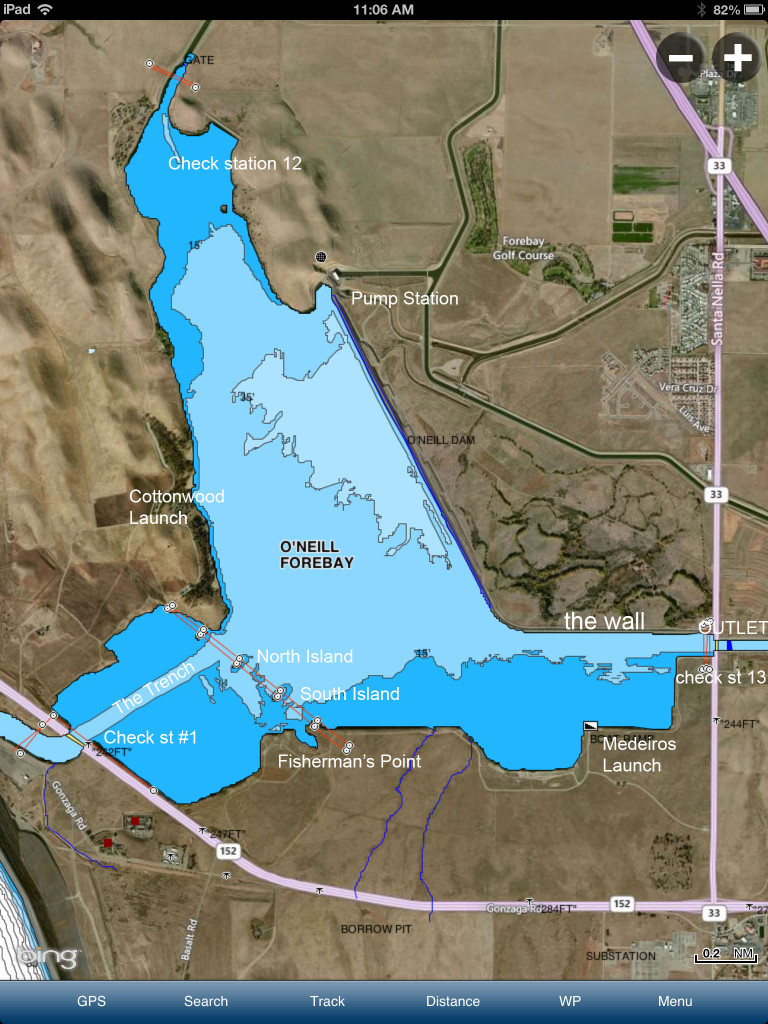
O’Neill Forebay: The Crossroads
O’Neill Forebay is much more important than its relatively small size suggests. Think of O’Neill as the mixing bowl and switching yard for San Luis Reservoir. State Water Project water arrives directly through the California Aqueduct. Federal Central Valley Project water arrives through the Delta-Mendota Canal and is pumped approximately 45 to 53 feet into O’Neill Forebay by the O’Neill Pump-Generating Plant. Now the water is sitting at the bottom of the hill beneath San Luis Reservoir. It still has one enormous climb ahead of it.
Gianelli Pumps It Into San Luis
The William R. Gianelli Pumping-Generating Plant is the heart of San Luis Reservoir. Eight enormous reversible pump-generators connect O’Neill Forebay with San Luis Reservoir. When California has water available for storage, Gianelli pumps water uphill from O’Neill Forebay into San Luis Reservoir. When agricultural and urban demand increases, the process can be reversed. Water runs downhill from San Luis through the same plant, generating electricity as it returns to O’Neill Forebay. From there it can continue south through the San Luis Canal/California Aqueduct or enter other parts of the federal water-delivery system. That means San Luis isn’t simply a lake whose water level rises after a rainy winter. Its water level is actively managed. Pumps fill it. Water deliveries empty it. And those operations can move enormous quantities of water.
For a fisherman, that’s important. Current in San Luis may not look anything like current in a river, but when those pumps are operating, water is moving—and baitfish and striped bass can respond to that movement and actually spawn.
Dos Amigos is downstream of O’Neill Forebay.
After water leaves O’Neill and heads south through the San Luis Canal portion of the California Aqueduct, Dos Amigos lifts that water another approximately 113 feet so gravity can continue carrying it south.
So the simplified State Water Project route looks like this:
Sacramento-San Joaquin Delta → Clifton Court Forebay → Banks Pumping Plant → California Aqueduct → O’Neill Forebay → Gianelli → San Luis Reservoir
The federal route is slightly different:
Sacramento-San Joaquin Delta → Jones Pumping Plant → Delta-Mendota Canal → O’Neill Pump-Generating Plant → O’Neill Forebay → Gianelli → San Luis Reservoir
And this brings us to something I’ve always found fascinating.
How Did the Fish Get Here?
San Luis Reservoir wasn’t stocked with some unique strain of landlocked striped bass. It is connected—hydraulically—to the Delta population. So theoretically, a small striped bass, threadfin shad or other fish originating in the Delta can get swept into California’s enormous water-export system and eventually find itself more than 100 miles away in O’Neill Forebay or San Luis Reservoir. But that is one hell of a ride. A fish following the federal route toward O’Neill must first encounter the massive C.W. “Bill” Jones Pumping Plant near Tracy. And before reaching those pumps, it encounters something specifically designed to prevent that journey. The Tracy Fish Collection Facility
Immediately upstream of the Jones pumps is the Tracy Fish Collection Facility. The facility was constructed in the 1950s to intercept fish being drawn toward the Central Valley Project pumps. It isn’t simply a screen stretched across the canal. The system uses trash racks, louvers, bypass channels, secondary screening and holding tanks to separate fish from the tremendous volume of water headed toward the pumps. Collected fish can then be transported and released back into the Delta. The facility handles numerous species, including salmon, steelhead, Delta smelt, American shad, threadfin shad—and striped bass.
In fact, striped bass create an interesting problem at Tracy. They’re predators. Stripers can accumulate around the fish-collection structures and eat smaller fish that the facility is trying to save. Reclamation has therefore studied predator removal and other methods of improving survival through the facility. But no fish-salvage system is perfect. Some fish inevitably continue with the exported water. Those survivors can enter the Delta-Mendota Canal, travel south toward O’Neill Forebay and potentially become part of the San Luis ecosystem. In addition The State Water Project has its own fish-protection facility associated with the Banks pumping system. So San Luis Reservoir isn’t biologically isolated from the Delta.
The plumbing that brings San Luis its water can also bring it life.
Threadfin shad, American shad and striped bass are all part of this interconnected system. For someone trying to understand the San Luis striper fishery, that’s a very important piece of the puzzle.
The Mussel Story Has Completely Changed
For years, boats entering San Luis were inspected to prevent quagga and zebra mussels from entering the reservoir. I always found that somewhat ironic. We were meticulously inspecting fishing boats while billions of gallons of water were arriving through an enormous plumbing system directly connected to the Sacramento-San Joaquin Delta. It turns out there was another invasive mussel coming through that system that nobody in California had dealt with before.
The Golden Mussel Arrives
In October 2024, California announced the first known North American discovery of the invasive golden mussel (Limnoperna fortunei) in the Sacramento-San Joaquin Delta. Golden mussels were subsequently confirmed in O’Neill Forebay. Then, in September 2025, golden mussel larvae—called veligers—were confirmed in samples associated with the Pacheco Pumping Plant, which draws directly from San Luis Reservoir. So the situation today is fundamentally different from when I originally wrote this section. Golden mussels are already in the San Luis water system. The same water-delivery network connecting the Delta to O’Neill Forebay and San Luis R eservoir provides a pathway for microscopic aquatic organisms to move through the system.
Why Are They Still Inspecting Boats?
Because once an invasive mussel establishes itself in one reservoir, the problem changes from simply keeping it out to preventing people from carrying it somewhere else. California State Parks now requires inspections associated with San Luis Reservoir, and after the golden mussel detection, mandatory inspections of vessels leaving San Luis Reservoir were instituted to reduce the chance of boaters transporting the mussels to currently uninfested lakes. That’s an important distinction. The inspection isn’t only about protecting San Luis anymore. It’s about protecting the next lake you fish. Golden mussel larvae can survive in standing water hidden inside bilges, live wells, motors, bait buckets and other equipment. That’s why the basic rule remains:
Clean. Drain. Dry.
Everything. That includes boats, trailers, float tubes, waders, fins, anchors, ropes, bait containers and fishing equipment that retains water. California State Parks advises boaters coming from infested water to thoroughly clean and drain their equipment and, depending upon circumstances, either use an approved decontamination process or keep the watercraft dry for as long as 30 days before launching elsewhere. For current San Luis rules, however, always check with State Parks before launching because inspection, sealing, quarantine and decontamination requirements can change.
Another Experiment Begins
There is a strange symmetry to all of this. Striped bass arrived in California because people intentionally transported a few hundred fish across the continent and released them into a completely new ecosystem. More than 140 years later, golden mussels arrived accidentally and began spreading through some of the same waterways the stripers colonized. One became one of California’s greatest gamefish. The other may become one of California water managers’ biggest headaches.
And both demonstrate the same thing:
Once an organism gets into this interconnected system of rivers, canals, pumps, forebays and reservoirs, it can be extraordinarily difficult to stop.
San Luis Reservoir may look like an isolated lake surrounded by dry California hills. It isn’t. It’s connected to the Delta by one of the largest plumbing systems ever built. And if you’re trying to understand the stripers in San Luis, you have to understand the plumbing.
The Big Fish Years — Where Did the Giants Go?
Anyone who fished San Luis Reservoir and O’Neill Forebay during the 1980s and early 1990s remembers that this was once genuine giant-striper water. Thirty- and 40-pound fish were caught with enough regularity that fishermen knew truly enormous stripers were swimming there. The ultimate proof came on May 7, 1992, when Hank Ferguson caught a 67½-pound striped bass from O’Neill Forebay, a California state record that still stands today. O’Neill produced several other record-class stripers during this period. Something about this strange combination of Delta water, pumping plants, abundant forage and reservoir habitat once produced some truly enormous fish. The old timers who have flyfished the lake since the 70’s all seem to feel that fishing pressure and poaching changed the lake. I disagree. So what happened?
The Giants Probably Didn’t Arrive as Giants
San Luis Reservoir isn’t biologically isolated from the Sacramento-San Joaquin Delta. The same enormous plumbing system that brings Delta water into O’Neill Forebay can bring fish with it. Historically, young striped bass were entrained with exported Delta water and transported into the San Luis system. But it’s unlikely that the 30-, 40- and 50-pound stripers of the glory years routinely traveled through that entire system as adults. The more plausible explanation is much more interesting:
They arrived small and grew big here.
Consider the 67½-pound record fish caught in 1992. A striped bass that size was almost certainly a very old female. Without scales or otoliths from that particular fish, her exact age can’t be determined, but a fish of that size could plausibly have been 20 to 30 years old or older. Work backward from 1992 and the timing becomes fascinating. A 25-year-old fish would have been born around 1967, almost exactly when the newly constructed San Luis Reservoir was being filled and becoming operational. A 30-year-old fish would have been born before San Luis Reservoir even existed.
We can’t know where that particular fish was born. But she could have entered the San Luis system as a young Delta striper during the reservoir’s early years and then spent the next two or three decades growing in O’Neill Forebay and San Luis Reservoir. That may be the story of many of the legendary fish from the 1980s and early ’90s: The Delta supplied the young fish. San Luis grew the giants.
Something Changed in the 1990s
The timing of the decline in giant San Luis stripers becomes especially interesting because the management of the Sacramento-San Joaquin Delta changed substantially beginning in the early 1990s. The Central Valley Project Improvement Act was passed in 1992, adding fish and wildlife protection as a major purpose of the federal water project and dedicating significant water to environmental objectives. The Delta smelt was listed under the federal Endangered Species Act in 1993. Protection of winter-run Chinook salmon, steelhead and other native species also increasingly influenced operation of the Delta export pumps. California also ended its striped-bass hatchery stocking program in 1992, partly because of concern that striped bass were predators of endangered salmon.
Over the following decades, biological opinions, water-quality requirements and court decisions increasingly affected when, how much and under what conditions water could be pumped from the Delta. Additional restrictions associated with Delta smelt and salmon became particularly significant during the 2000s. For San Luis stripers, that matters.
If young striped bass historically entered O’Neill and San Luis with exported Delta water, then changing the timing and volume of those exports could also change the number, size and timing of striped bass entering the system. That doesn’t prove that changes in Delta pumping caused the decline of San Luis’s giant stripers. But the timing makes it a question worth asking.
What About the Fish Screens?
Fish-protection facilities at the Delta pumps aren’t new. The federal Tracy Fish Collection Facility began operating in the 1950s and the state’s Skinner Fish Protective Facility in the 1960s, so simply saying that screens were installed and the big stripers disappeared doesn’t fit the historical timeline.
What did change were the technology and operating procedures. Fish collection, salvage, monitoring and predator-control methods have been modified and improved over the decades. Those systems are intended largely to protect fish from being lost through the pumps, but they also intercept striped bass.
So improved fish protection could be one factor affecting the number of young stripers reaching San Luis, but I haven’t found evidence showing that it was the primary cause of the decline in large fish. The bigger story may be the overall change in Delta exports and striper recruitment.
The Effect Would Take Years to Show Up
This is where the biology becomes particularly interesting. If fewer young stripers began entering San Luis sometime during the 1990s, the big fish wouldn’t suddenly disappear. The reservoir already contained generations of older fish. Those fish would continue growing and producing trophy catches for years. Only as those older cohorts gradually disappeared would reduced recruitment begin showing up in the larger size classes.
A 10- or 15-pound striper represents years of survival and growth. A 20-, 30- or 40-pound female represents considerably more. So a major change in recruitment beginning around 1992–2000 might not become obvious in the trophy fishery until years—or even a decade or more—later. That’s exactly why looking only at today’s population can be misleading.
The big fish swimming in San Luis today may reflect what happened in the Delta many years ago.
Are Today’s Big Fish Homegrown?
I think they probably are. Ive cught many tiny stripers every year. Pumped in from the forebay perhaps? I think more likely spawned in the Lake. Young stripers can still enter through the water-delivery system. Once inside O’Neill and San Luis, some of those fish become residents and spend years feeding on threadfin shad and other forage.
By the time one of those fish weighs 15, 20 or 30 pounds, I suspect we’re looking primarily at a San Luis-grown fish, not a recent adult immigrant from the Delta. That changes how I think about this fishery. San Luis may not receive a continuing supply of trophy stripers from somewhere else. Instead, it receives recruits. Some survive. A few survive for a very long time. And an extraordinarily small number become giants.
Could Poaching Have Killed the Big-Fish Population?
One explanation I’ve heard for the disappearance of San Luis’s giant stripers is that heavy poaching during the 1990s removed so many small fish that there simply weren’t enough left to grow into the next generation of 20-, 30- and 40-pound fish. I’m skeptical that poaching of small fish, by itself, explains what happened. Striped bass are extraordinarily prolific. A mature female can produce hundreds of thousands of eggs in a spawning season, and a large female can produce well over a million. The overwhelming majority of those offspring will never become adult fish. Mortality among eggs, larvae and juveniles is enormous even in a healthy population. The population’s eventual size therefore isn’t determined simply by how many eggs are produced—or even by how many small stripers exist at a particular moment—but by how many fish successfully survive through each stage of life. San Luis has also continued to hold very large numbers of small stripers. That’s important. If excessive harvest of juveniles in the 1990s had been severe enough to eliminate the future trophy population, I would expect evidence of a major recruitment failure or shortage of younger fish. Instead, the continuing abundance of small stripers suggests that producing or acquiring young fish has not necessarily been San Luis’s biggest problem.
The more interesting question may be what happens after they’re small. Imagine a reservoir containing tens or hundreds of thousands of juvenile stripers. Only a tiny fraction need to survive long enough to become 10-pound fish, and an even smaller fraction need to survive for decades to produce a handful of 30- or 40-pounders. A poacher can remove a lot of fish. But removing enough small stripers from a reservoir the size of San Luis to permanently alter its population structure would require enormous and sustained harvest relative to the number of young fish being produced or continually entering with imported water. That’s possible in principle, but I’ve seen no evidence demonstrating that it actually occurred at a scale sufficient to explain the disappearance of the giants.
Harvesting large fish is a different biological question. Removing a 25-pound female eliminates a fish that may have required well over a decade to reach that size. Removing a 40-pounder eliminates an even rarer survivor. Those old fish can’t be replaced the following year simply because millions of eggs are produced. So fishing mortality could certainly contribute to the loss of the largest size classes, particularly if large fish were specifically targeted.
But the claim that poachers caught too many small stripers in the 1990s and thereby killed the future trophy fishery doesn’t completely satisfy me. There are still plenty of small fish. What seems to be missing are the fish that successfully make the journey from small → medium → large → giant. That shifts the question. Instead of asking:
“Why aren’t enough baby stripers being produced?”
perhaps we should be asking:
“Why aren’t more of the enormous numbers of small stripers in San Luis surviving and growing into 15-, 20- and 30-pound fish?”
That opens up a very different set of possible explanations—changes in forage, growth rates, water temperature, reservoir drawdowns, pumping patterns, habitat, disease, competition, harvest of larger fish, or changes in the age and size structure of the population. Striped bass biology gives San Luis an enormous supply of lottery tickets. The mystery isn’t why there aren’t enough tickets.
It’s why so few of them seem to become winners anymore.
Did something change in the 1990s that substantially reduced the number of young Delta stripers entering San Luis Reservoir?
Because if the Delta supplied the recruits and San Luis grew the giants, then changing that supply of young fish could alter the trophy fishery decades later. And perhaps the most intriguing evidence is still that 67½-pound fish caught in 1992. She may have entered the system when San Luis Reservoir was practically brand new. The Delta may have supplied her. But San Luis made her a 67-pound striper.
SAFETY
San Luis Reservoir can be an incredibly dangerous place to boat. It’s easy to underestimate because on a calm morning San Luis can look almost harmless—a huge, open lake surrounded by rolling hills. But those same hills funnel wind across the reservoir, and conditions can change remarkably fast. A lake that was comfortable an hour earlier can become rough enough to overwhelm a small boat. Strong winds across the long stretches of open water can quickly generate steep, closely spaced waves. In winds around 20 mph, waves of several feet are possible, and they aren’t the long rolling swells you might encounter on the ocean. They can be short, steep and relentless.
I’ve seen San Luis go from fishable to frightening very quickly.
For boats under about 18 feet, especially low-freeboard fishing boats, those conditions can become dangerous. Taking just a few waves over the stern can put hundreds of pounds of water into a boat. Once that happens, the stern rides lower, making it easier for the next wave to come aboard. That’s how a manageable problem can become an emergency remarkably quickly.
And simply “heading for shore” isn’t always a good solution at San Luis. Depending upon where you are, the nearest shoreline may consist of steep banks or rocks. Near B.F. Sisk Dam and the trash racks, getting yourself and a boat safely onto shore can be extremely difficult.
Pay Attention to the Warning Lights
The San Luis Reservoir State Recreation Area includes San Luis Reservoir, O’Neill Forebay and Los Banos Creek Reservoir. All can experience sudden changes in wind and weather. San Luis Reservoir and O’Neill Forebay use warning lights to alert boaters to deteriorating conditions. On San Luis Reservoir, warning lights have historically been located around the Basalt area, Quien Sabe Point and Romero Visitor Center. O’Neill Forebay also has warning lights visible from the water.
The system is simple:
| Condition | Warning |
|---|---|
| Normal conditions | Lights off |
| Caution | Amber |
| Lake closed to boating | Red |
An amber light means pay attention. Conditions are becoming hazardous or another safety concern exists. A red light means the lake is closed to boating. Boats on the water are required to return to shore. Don’t treat the amber light as an invitation to squeeze in another hour of fishing. If I’m a long way from the ramp and the wind is building, I would rather head back too early than five minutes too late. For current conditions and access information, check with San Luis Reservoir State Recreation Area before launching.
The Accident I Never Forgot
One incident has stayed with me for nearly twenty years. In June 2006, Mark Harrup died while fly fishing San Luis Reservoir. Mark was only 29 years old. He was a professional fly fisherman, worked at the San Jose Fly Shop and coached JV golf at Leland High School. He was also one of the most experienced fly fishermen I knew. He was fishing that evening with Jeff Ketelson, who survived the accident and later told me what happened. They had initially been fishing in relatively protected water. When the wind appeared to settle down, they decided to make a run toward one of their favorite areas near the trash racks at the dam. They found fish. At one point they hooked a double. While their attention was on the stripers, neither fisherman initially noticed that water was beginning to accumulate in the back of their 15½-foot Cobia. By the time they recognized the problem, they were drifting dangerously close to the dam. They tried the motor. They tried the bilge pump. They had trouble with both.
Eventually they managed to start the engine and attempted to get the boat moving fast enough to help clear the water. But with so much water already aboard, the stern was riding extremely low. The engine became wet and failed. Now they had a partially flooded boat, no engine and four-foot waves near the dam. Then the boat capsized.
Initially, Mark and Jeff were able to stay with the overturned boat. They assumed the hull would continue floating and give them something to hold onto. It didn’t. As the trapped air escaped, the boat began sinking beneath them. Suddenly they weren’t fishermen dealing with a disabled boat. They were two men in rough, cold water with daylight disappearing. They grabbed whatever floating debris they could find. Jeff remembered Mark struggling. He pushed a piece of floating material toward him and then swam toward a fuel tank that was drifting away. Eventually they lost sight of each other.
Jeff managed to reach a cable near the trash racks and held onto it for approximately three hours before rescuers reached him shortly before midnight. Mark didn’t survive.
Accidents Usually Aren’t One Big Mistake
I’ve thought about that accident many times. The lesson I took from it isn’t that Mark and Jeff made one terrible decision. It’s almost the opposite. Serious accidents are often a chain of small problems that individually seem manageable.
The wind had settled. They moved to another fishing spot. They were catching fish. Some water entered the boat. The bilge pump didn’t solve the problem. The engine eventually started. Then the engine failed. The boat flooded. The boat capsized. And suddenly there were no more manageable problems. There was an emergency. Mark wasn’t a strong swimmer and was wearing jeans and heavy shoes. Neither fisherman was wearing a life jacket when the boat went over. By the time they realized they needed them, there wasn’t enough time to retrieve them. They also believed the overturned boat would remain afloat. It didn’t. Those details changed the way I think about boating on San Luis.
Wear the Damn Life Jacket
I don’t care how good a swimmer you are. I don’t care how calm the lake looks when you leave Dinosaur Point. And I don’t care how many years you’ve been boating. Wear your PFD while you’re fishing San Luis. Modern inflatable PFDs are so light that there’s almost no reason not to wear one. Put it on at the ramp and forget about it. Make sure your bilge pump works before you launch. Carry a backup method of removing water. Make sure the battery and engine are reliable. Keep your phone or VHF radio protected and attached to you—not sitting in a compartment that disappears with the boat. And when the wind begins building, don’t wait until conditions become dangerous before heading home. I’ve spent a lifetime around water, and San Luis still commands my respect. The stripers aren’t worth your life.
World-Class Fly Fishing for Landlocked Stripers
San Luis Reservoir and O’Neill Forebay deserve to be mentioned among the world’s great places to catch landlocked striped bass on a fly. That’s not just hometown pride. The record book proves it. For decades, San Luis and O’Neill dominated the IGFA fly-tackle records for landlocked striped bass. Some of those records still stand more than 30 years later. The greatest of them all was caught on September 17, 1989, when Alfred “Al” Whitehurst landed a 54-pound, 8-ounce striped bass from O’Neill Forebay on 16-pound tippet. He caught it on a fly. From a float tube.
Think about that for a moment—a 54½-pound striper hooked while sitting at water level with your legs hanging beneath you. That fish remains the IGFA men’s 16-pound tippet-class world record for landlocked striped bass. And Whitehurst didn’t do it just once. He went on to set additional IGFA records at San Luis Reservoir, including a 32-pound, 12-ounce fish on 4-pound tippet in 1993, a 29-pound, 8-ounce fish on 2-pound tippet in 1994, and a 39-pound, 8-ounce fish on 8-pound tippet in 1996.
Leonard Bearden Jr. added another monster in January 1995: 49 pounds on 20-pound tippet from San Luis Reservoir.
Look at the current men’s IGFA tippet-class record book and the concentration is remarkable:
| Tippet | Weight | Location | Date | Angler |
|---|---|---|---|---|
| 2 lb | 29 lb 8 oz | San Luis Reservoir, CA | Apr. 3, 1994 | Alfred Whitehurst |
| 4 lb | 32 lb 12 oz | San Luis Reservoir, CA | Nov. 28, 1993 | Alfred Whitehurst |
| 6 lb | 45 lb 1 oz | Cumberland River, KY | May 21, 2000 | Dr. John Baldwin |
| 8 lb | 39 lb 8 oz | San Luis Reservoir, CA | May 1, 1996 | Alfred Whitehurst |
| 12 lb | 43 lb 2 oz | Cumberland River, KY | Apr. 25, 1999 | Gerald McDaniel |
| 16 lb | 54 lb 8 oz | O’Neill Forebay, CA | Sept. 17, 1989 | Alfred Whitehurst |
| 20 lb | 49 lb 0 oz | San Luis Reservoir, CA | Jan. 28, 1995 | Leonard Bearden Jr. |
Five of the seven men’s fly-tackle tippet-class world records shown in the current record book came from San Luis Reservoir or O’Neill Forebay. Even more remarkable, four belong to Al Whitehurst. These aren’t records set last year that might disappear next season. The San Luis records date from 1989 through 1996 and remain standing decades later. Many , Many stripers of this class have been caught in the lake since by the likes of Roger George and other veterannon fly fishermen suggesting that the population of large stripers is as healthy as every. Perhaps they are deeper now with current water pumping polocies.
Why San Luis Is So Special for a Fly Fisherman
Plenty of reservoirs contain landlocked striped bass. Far fewer combine very large fish with water that can actually be fished effectively with a fly rod. That’s the magic of San Luis and especially O’Neill Forebay.
Stripers here feed heavily on relatively small baitfish, particularly threadfin shad. A three-inch Clouser, Deceiver or other shad imitation can therefore represent exactly what a large striper is looking for. A 20-pound fish doesn’t necessarily want a 10-inch meal. Sometimes it wants the same three-inch shad being eaten by the schoolies. That creates one of the things I love most about San Luis fly fishing: You never really know what size fish is going to eat the fly. You can catch a succession of 16-inch stripers and then make exactly the same cast with exactly the same fly and hook something that immediately takes you into your backing.
O’Neill is particularly suited to fly fishing because so much of its productive water is relatively shallow. Flats, weed lines, riprap, channels and submerged structure can all be reached with conventional fly tackle. Intermediate and sinking lines allow a fly fisherman to cover much of the water column, while fall schools of stripers chasing shad to the surface can sometimes be targeted with floating lines and topwater flies.
San Luis Reservoir adds an entirely different dimension: a huge body of deep, open water with rocky shorelines, points, submerged islands and steep structure where genuinely large fish still live. And we know what the system is capable of producing. The California state-record striped bass—67 pounds, 8 ounces—came from O’Neill Forebay in 1992.
So when you’re stripping a three-inch fly through San Luis or O’Neill, you’re fishing water that has produced a 67½-pound striper on conventional tackle and a 54½-pounder on a fly. That’s a pretty good definition of trophy potential.
And It’s Practically in the Bay Area’s Backyard
Perhaps the most remarkable thing about San Luis is where it is. This isn’t some remote Canadian lake requiring a floatplane or a famous Southern reservoir requiring a cross-country trip. It’s roughly 72 miles from San Jose, just beyond Pacheco Pass. From much of the South Bay, world-class landlocked striped-bass fly fishing is close enough for a day trip.
You can leave the Bay Area in the morning, drive through Gilroy and over Pacheco Pass, launch a boat or float tube, and spend the day casting flies in water that still holds five of the seven men’s IGFA landlocked striped-bass tippet-class world records. There may be inland striper fisheries that produce more fish today, and there are reservoirs that occasionally produce enormous stripers. But very few places combine record-class fish, fly-fishable water, decades of fly-fishing history and proximity to a major metropolitan area the way San Luis Reservoir and O’Neill Forebay do. For a Bay Area fly fisherman, that’s what makes San Luis extraordinary. One of the world’s great landlocked striped-bass fly fisheries has been sitting in our backyard all along.
What Can You Safely Eat from San Luis, O’Neill and the Delta?
Striped bass are excellent eating fish—but if you’re going to keep fish from San Luis Reservoir, O’Neill Forebay or the Delta, there is another consideration besides the fishing regulations:
Mercury and PCBs.
California’s fish-consumption recommendations are issued by the Office of Environmental Health Hazard Assessment (OEHHA), part of the California Environmental Protection Agency. OEHHA tests fish for contaminants and balances those results against the nutritional benefits of eating fish. And the recommendations for striped bass are surprisingly different depending upon where you catch them.
San Luis Reservoir has the most restrictive striped-bass recommendation of the three. Testing found relatively high mercury concentrations in San Luis stripers. In the data used to develop the advisory, the mean mercury concentration in San Luis Reservoir striped bass was 782 parts per billion.
Current OEHHA advice is:
| Who | San Luis Reservoir Striped Bass |
|---|---|
| Women ages 18–49 and children ages 1–17 | DO NOT EAT |
| Women 50+ and men 18+ | Maximum 1 serving per week |
A serving is approximately the size and thickness of your hand. Children receive smaller portions. Other San Luis species have different recommendations, so fishermen who regularly eat their catch should check the current OEHHA advisory rather than assuming that advice for stripers applies to every fish in the reservoir.
O’Neill Forebay Is Different
Interestingly, O’Neill Forebay has a separate advisory. Current OEHHA recommendations allow:
| Who | O’Neill Forebay Striped Bass |
| Women ages 18–49 and children ages 1–17 | 1 serving per week |
| Women 50+ and men 18+ | 2 servings per week |
That’s an important distinction. San Luis Reservoir and O’Neill Forebay are physically connected and exchange enormous quantities of water, yet contaminant concentrations measured in their fish have resulted in different consumption recommendations.
What About Delta Stripers?
The Delta has its own advisories. For the Central and South Delta, OEHHA currently recommends that women ages 18–49 and children ages 1–17 not eat striped bass. For women 50 and older and men 18 and older, the recommendation is no more than one serving per week. So simply saying “Delta striper” or “San Luis striper” isn’t enough when deciding how often to eat one. Where the fish was caught matters.
Why Bigger Fish Concern Me
My personal rule is even simpler: I release the big stripers. There are two reasons. The first is conservation.
A 15-, 20- or 30-pound San Luis striper has survived for many years. These are exactly the fish that make San Luis a special fishery, and they’re increasingly uncommon compared with the tremendous numbers of smaller stripers in the reservoir. Once you kill a 25-pound fish, replacing it isn’t a matter of waiting until next season. Another fish has to survive and grow for many years to take its place.
The second reason is contaminant accumulation.
Mercury bioaccumulates in fish. As predators grow and consume other organisms containing mercury, it accumulates in their tissues. Long-lived predators such as striped bass can therefore carry substantially greater contaminant burdens than many smaller, shorter-lived fish. That doesn’t mean every large striper contains a particular amount of mercury, and OEHHA’s current San Luis advisory does not establish a special 10-pound or 27-inch cutoff. So I wouldn’t claim that a striper under 10 pounds is automatically “safe” while one over 10 pounds isn’t. But from both a fishing and consumption standpoint, keeping a smaller legal fish makes much more sense to me than killing one of San Luis’s increasingly rare giants.
Preparing Fish Matters Too
OEHHA recommends eating only the skinless fillet. Remove the skin and discard the guts and fatty portions before cooking. PCBs and some other contaminants accumulate disproportionately in the skin, fat and internal organs. Cooking the fish so that fat and juices can drain away can reduce exposure to some of these contaminants. Mercury is different. It’s distributed throughout the muscle tissue, so cleaning and cooking cannot remove mercury from a fish. That’s why the consumption limits themselves matter.
My Rule for San Luis
The Good Old Days
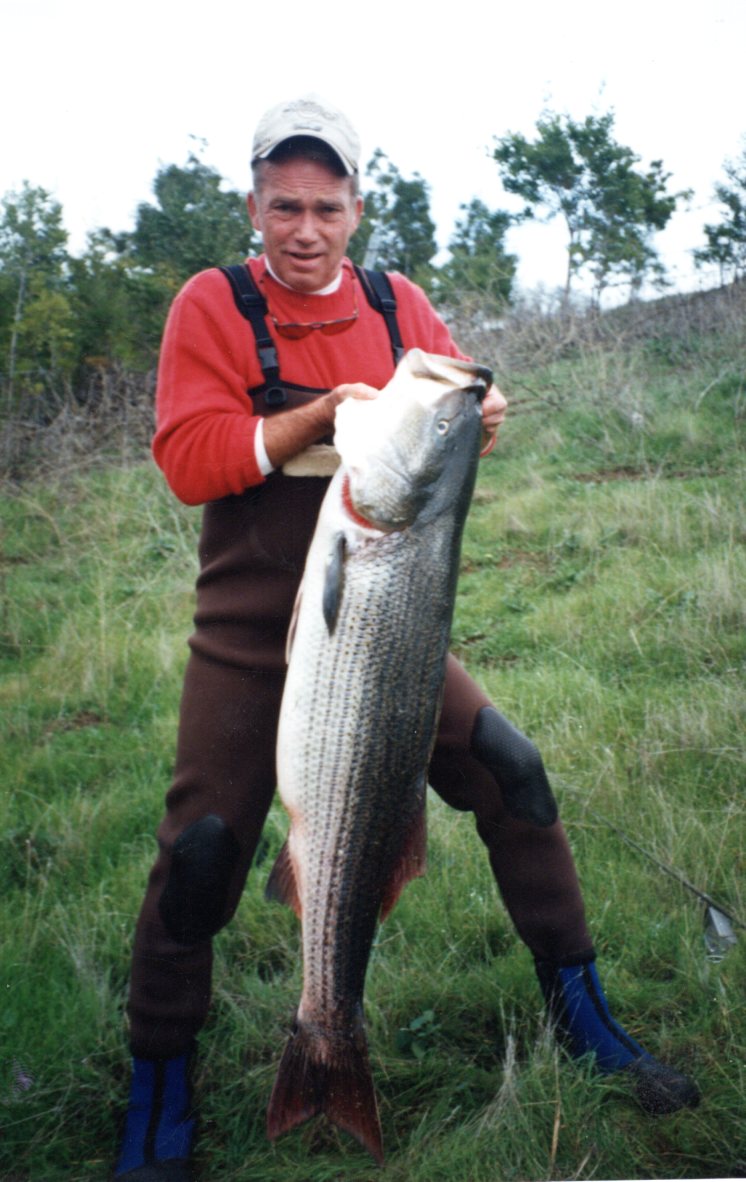
My Dad in 1964 (I was 8)

My first anchovy caught Striped Bass in 1970. I was 13 years old .
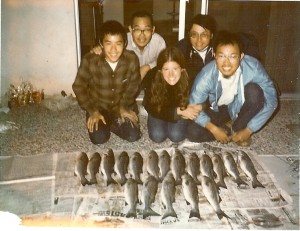
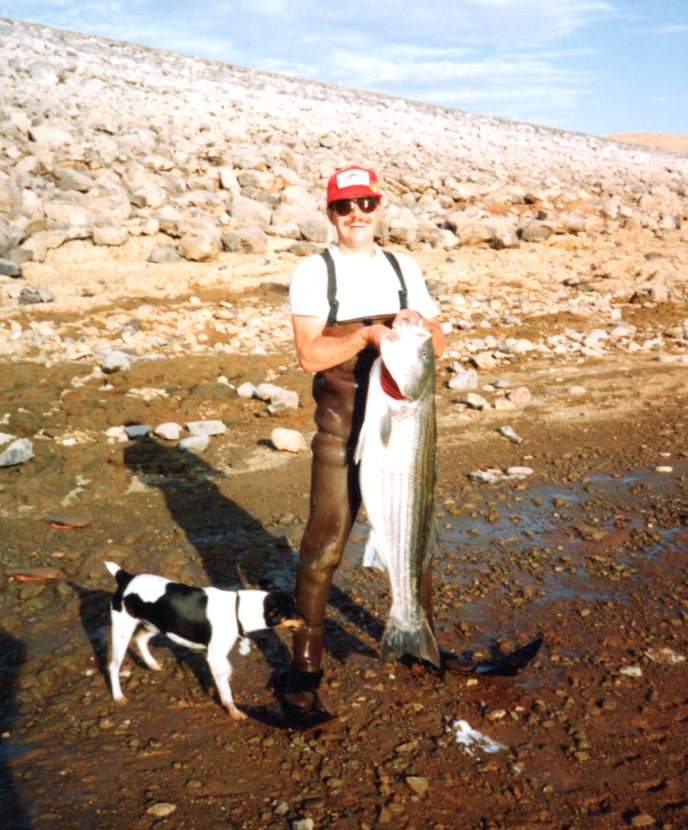
“a mess of stripers” 1973
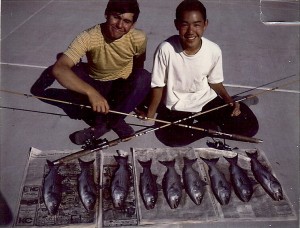
Joey Baiocchi and I with some Stripers 1974
Back in 1972, when I started working at the Millpond Fly Shop, I started flyfishing San Luis off the shoreline primarily for American Shad. The Shad in those days would swim in large schools around the lake . Some were as large as 6 lbs. I have seen dead stripers in San Luis with foot long Shads sticking out of their mouths choking them to death. The American Shad if a forage food for giants and thus the large size of San Luis Strippers. I remember when Kay Mitsioshi who worked at the Millpond back then, showed me how to prepare and eat the roe of large female Shad–it was a Japanese delicacy and he encouraged me to bring him back some hens. It was also in the 70s when my boss, Len Bearden, started to seriously fly fish San Luis for large stripers. He made San Luis his home water. By 1975 Len had accomplished the Grand Slam of Saltwater Sailfish Flyfishing–having caught every species of sailfish on a fly when saltwater flyfishing was in its infancy. Len approached fishing San Luis like a scientist. He started keeping detailed records of the wind weather conditions. He kept detailed records of fishing days on the water and recorded all of Al’s observations when they spoke. Fishing it almost twice weekly for over 5 years, Len knew every nuance of the Lake. When I fished with him, it was not unusual for him to be the only guy in a line of float tubes constantly hooking fish which taught me the most enlightening lesson I ever learned from him – there is more to catching Stripers on San Luis and ONeill Forebay than time on the water and luck. Everyone who fished with him accept Al, was at a disadvantage because he knew things that other did not. I watched him fish next to Dave Whitlock, and other famous fishermen and embarrass them on that lake. He use to tell me I was holding my lip wrong which back then meant I was not smoking a cigar. Len’s friend Al Whitehurst lived in the bay area and would come into the store and buy materials for all sorts of odd flies to fish the lake. He too was enamored with the stripers of San Luis Reservoir. They would communicate weekly about the fishing on the lake and between the two of them their knowledge of the lake compounded. In the next thirty years, the two of them would own all the IGFA Fly Caught line class World Records for Landlocked Stripers. Al eventually moved to Los Banos and remains there to this day–in my opinion, he is the world’s authority on San Luis fly fishing. The fly of choice back then for Len was yellow clouser minnow
It’s all about the weather! If you read the diary carefully, some of the best days Len had were in some of the worst weather–storms, wind and fog.
Len Beardend Striper Fly Fishing Diaries 1991-1992 Bearden Striper Diaries 91-92
Catch Journal 91-94 by MengSyn
Recent Landmark Catches
The Trifecta of 2016
The month of November 2016 was the month I broke the 20 lb mark that I eluded me for years. Conditions were ideal – water down to 18 percent, good weather and solonar. Big Flies, Big Fish. Don’t give up targeting big fish no matter what.
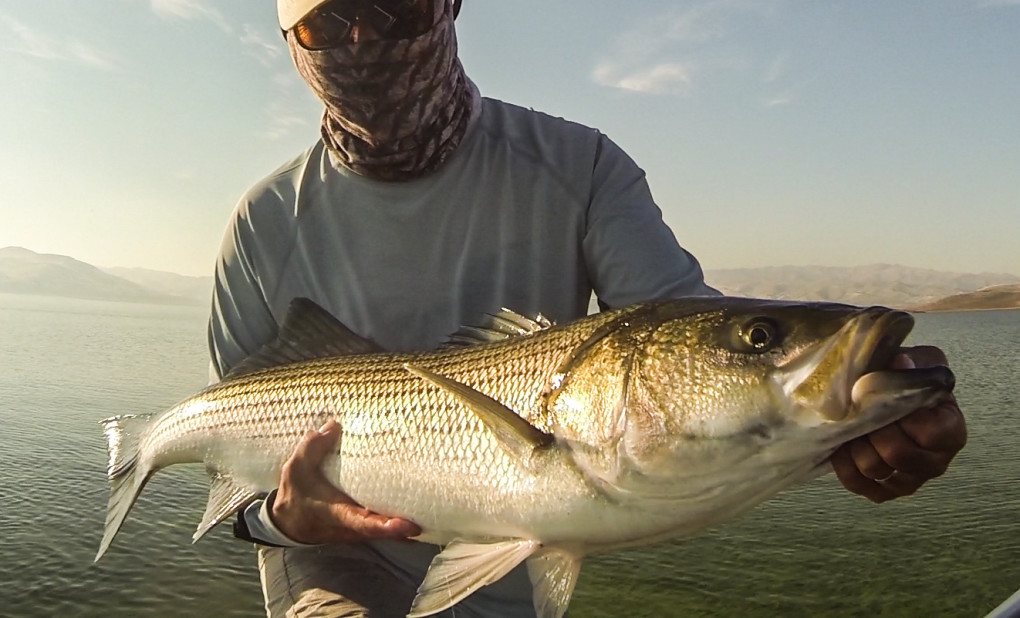
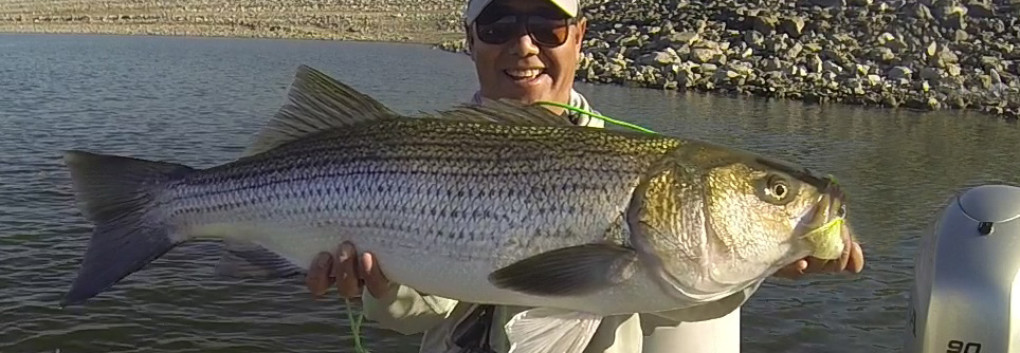
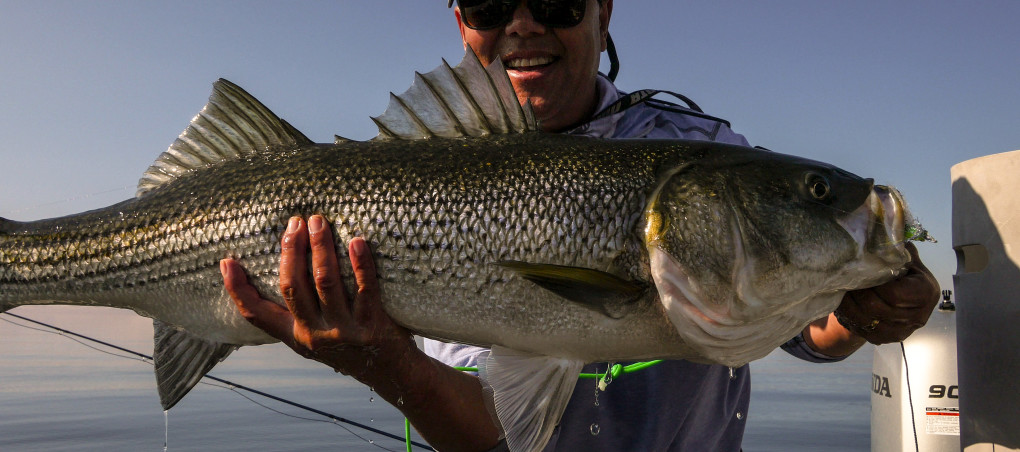
Steve Santucci’s 40 lbr October 2016
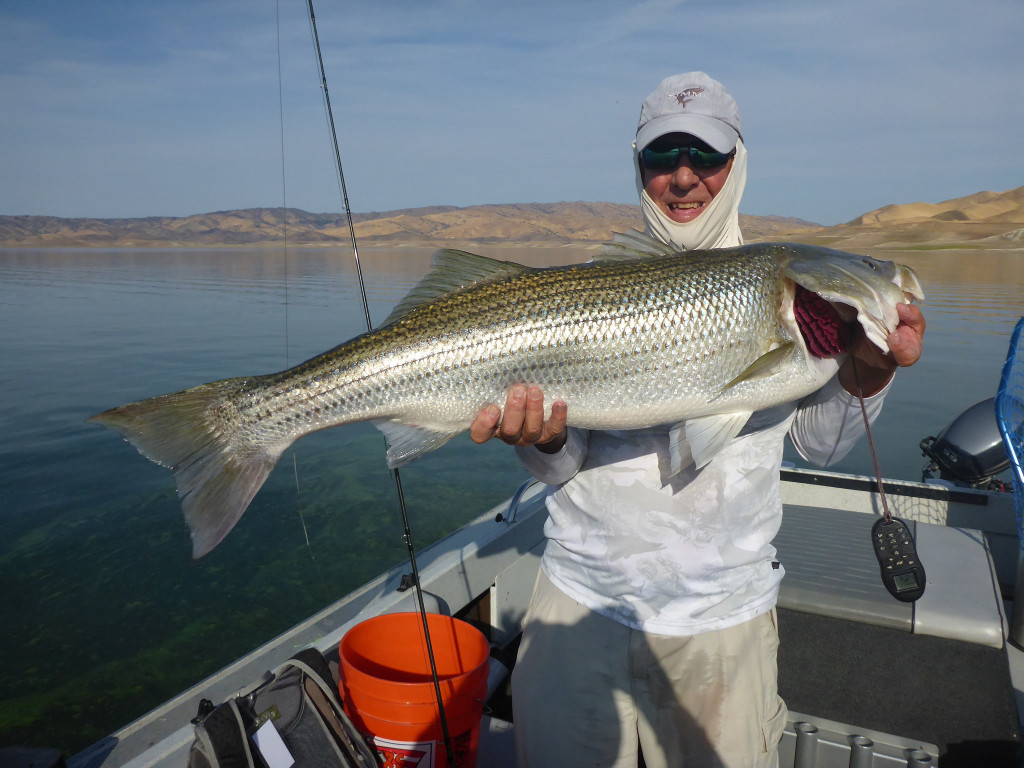
We were on the water by 7:45 and heading across the lake to the rocks of the dam. I hooked into the first fish within 5 minutes and the bloody thing was into my backing 100 yards in 30 seconds or less. We knew it was a good one.
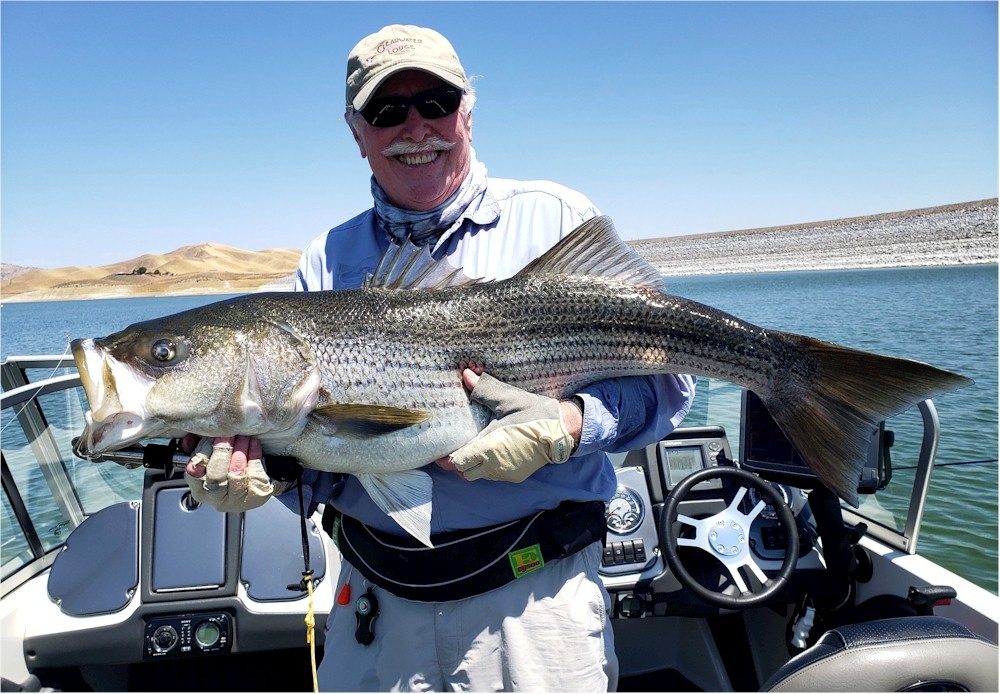
When we saw color, Ed says to me that it’s over 30 and I say don’t know about that but it’s a damned good one. Turns out it was 32 pounds – yes, I weighed it on the boga; we took a few photos and I took plenty of time to be sure she was properly revived. She swam away in good shape heading downward for deep water. Needless to say that I was stoked. It’s the best one for me in quite a while. I managed two other nice fish, an 8- and 9-pounder and a few smaller fish. Ed ended up with 18 fish from 18 to 20 inches; and we both dropped a few. Only a few days ago Ed hooked a monster that got into his backing more than a hundred yards before rocking him off.
32 lbs caught at Romero on a grey and white jig hook clouser
I happened on your site today, and what a wonderful and informative read you gave me. The history of the reservoir, and the fishing detail are fascinating. The Kennedy video was a treat and a nice history lesson. Thank you so much for sharing your experience and wisdom.
I rewatched that Kennedy speech after your kind words . I was 5 years old when he gave it. Listening to the words were inspiring and also sad that we are no longer a country like that . What vision he had . It seems it’s every State for themselves these days even though the Federal Government is chipping in for the Dam Project 2023.
I don’t fish that much now but growing up we did especially at San Luis. My Dad was the Chief of the San Luis Field Division for 20 years with DWR for 40 years. He did always know the best places to fish. This article brought back some great childhood memories.
Just a great history on an amazing body of water. I have fishes it a handfull of times and also fished the creek outlet for crappie.
Great read, thank you
Great article Meng, I will try to get out to Checkpoint 12 this weekend to just check the place out and enjoy the outdoors with no expectations but to just to enjoy myself in the outdoors with my wife.
Where would you recommend shore fishing with 8-12 year olds?
What’s the best bait to use?
Thank you.
You could try anchovies and live minnows which is what I fished with when I was 8-12. Call Coyote Bait and tackle and they will set you up.
This is one of the best reads I found yet on San Luis fishing.Thanks’ for your time and expertise on San Luis. I’ve been fishing for the 30lb bass my self for 30+ years off and on. I also keep a log book noting Weather, Water Levels, And Solunar etc: . I put together some short videos fishing there in October 2016 when the water was very low “almost dry” and then again June of 2017 when the reservoir was full to the top. here is a link to the videos.
Thanks again you rock!
https://www.youtube.com/watch?v=S5DS5thgdsU
What happened to the link? I was excited to go see
Wonderful historical prospective concerning one of my favorite fish ! I currently live in Redding and fear if the tunnels are built Shasta will become a mud hole and the Delta will be destroyed!
Most Nor Cal people are so ignorant of the threat that Southern California Water interests are to us. The most powerful weapon we fishermen have is the endangered species act and now our Senators are starting to waffle on that.
Fishing all over the state has Declined in a big way. You are correct to point out Regulations. Especially nearby population centers, I am of the opinion that ALL decent game fish should be Catch and Release only. How much longer until there are Zero fish in our waters, well just look at the graphs. Less than a decade left IMO. It always amazes me to see someone keep a fish in the bay area. Mercury is a serious carcinogen. If you want to keep something, keep a carp or bluegill, save a baby bass or trout this way.
National Geographic did a documentary on California Water that I think all fishermen should see–WATER & POWER: A CALIFORNIA HEIST. The politics and economics of water in California is heavily weighted against fish by the politicians that run out state. The only thing that stand between total destruction of the NORCAL water ecology is the endangered species act which is now under attack by California Politicians. We as fishermen are a very weak lobby without the endangered species act.
Great blog! Thanks for taking the time to put this together! ??
Great help, thank you!
Hello, do you allow guest posting on mengsyn.com ? 🙂 Let me know on my email
Thanks for share your post, Please checkout my article below:
Fishing 101: Top 10 Tips On Fishing For Beginners
https://guidancesports.com/fishing-for-beginners/
What a fantastic article, thank you.
This is my first time on this blog. I have fished my whole life but not so much for stripers. I live in Mountain View and would like to go fishing with someone who regularly fishes at San Luis. I have rods, lures etc. I am happy to buy all the bait, beer, gas, whatever it takes. Feel free to email me at wsmilestone@gmail.com if you have interest.
Thanks,
Will Stuart
I see you don’t monetize your site, there is one cool method to
earn extra money, it will work with your website perfectly,
just search in google for; tips and tricks by Fejlando
Any current reports for O’Neil Forebay for stripers on shore fishing?
I am very new to fishing and trying to learn as much as I can. We are going to San Luis and I wonder if you could recommend a good spot for shore fishing? I also have a kayak but I’m concerned about fishing from it after all the warnings about wind.
Jennifer Mitchell
Jeniffer, If you like fishing from a Kayak, I would try fishing in Oneill Forebay first. Most of the successful Kayakers in the forebay troll a lure or plastic swimbait around and do well. The Forebay is pretty small and you wont get into big trouble far from shore anywhere you fish on it. Also, I think you are safer in a Kayak than a boat if for some reason the wind does build. If you really want an advantage fishing the forebay, you can check out Coyote Bait and Tackle. They have recent fishing reports and they sell jumbo minnows. Live bait is pretty much a sure thing if there are fish around. I also like the Fresno Bee Fishing report for current conditions and places to fish. Check 12 is a good spot to fish from shore. Its right were the canal enters the forebay. If you ask the Ranger Station when you get your boat inspection (Make sure your kayaks is dry) they will direct you.
very through and well written. Last Fall the Forebay was poisoned to kill weed beds, the lifeblood of the lake. Now I had heard that this is going to be a regular practice throughout the year. This is very disturbing as many of us fly fishermen from the Santa Cruz Fly Fishermen group like to camp and fish the O’Neill Forebay late summer and fall. How is this going to change fishing there I wonder. Who can we petition to not continue this idea?
Steve Rudzinski
I enjoyed this article and thank you for sharing your experiences and thoughts. Recently retired I have been fishing the Forebay 3-5 tiimes a week by Kayak and in a short time have been catching and releasing numerous Stripers. Like mentioned in your blog most have been between 16-18 inches. Yesterday I caught my best in the Forebay at 26 inches. I unfortunately have seen many people ignore regulations or destroy any chance of the fish surviving when being released. Would like to see stiffer penalties or more being done to protect this great fishery.
For me the quality of the fishing experience at San Luis declined when the federal government transfered managment to the State of California. While a Federal Wildlife area I also enjoyed Pheasant Hunting near the Basalt area and duck hunting by skull boat. I stopped going when Dinosar Point was gated with dawn to dusk restrictions. I am not sure about access at Basalt, but it is probably the same. The Forebay has night access if you are willing to pay the CRAZY HIGH FEES. No point to it really since it fishes better from a boat. The key to fishing the main body is that at this lake, 80% of the fish occupy 30% of the water. When a ware changes with the seasons but is still the rule. I am willing to bet it is as good as ever but whats the point when you launch late or are forced to trailer your boat to early? For me the two most productive windows of opportunity were taken away and for no good reason other than money. What A SHAME.
Steve Johnson;San Jose California
great article. my dad lives in Fresno and talks about fishing here and how it is hit or miss. I now live in VA and we are planning a trip to fish a bunch of different spots in CA. We have gone to Lake Powell for the past two years but I want to stay local this year. Any tips you are willing to share would be much appreciated. he has a little Tracker boat so trolling is an option. Thanks!
Awesome Internet post! Thank you.
On April 21, 1991 Terry Baird, who held the 16 pound tippet record before I did, and I were fishing there in a moderate north wind. From 10:00 am until 7:00 pm we caught between us 22 fish over 15 pounds, including at least 8 over 20, a 30, and a 37, with many 4 to 15. That night Terry christened the Bay of Pigs, as we barbecued a fillet.
Next morning, with calm conditions, one fish between us about 20 inches.
The number of big fish has dwindled, but it is still a great fishery.
No I don’t
Meng–Do you know how the Bay of Pigs got its name?
Hello Meng,
I have been fishing for striped bass at Oneil forebay & San Luis reservoir for many years. I live about a mile away from Calero reservoir . I noticed the size of fish shrinking for about 7 years. Oneil forebay used to be a fantastic fishery, not anymore. The average size went from 26″ to 16″ in only 7years and that is alarming! Fishing pressure and current regs are to blame. I am seeing the same thing happen at San Luis reservoir . 6 years ago you could consistently catch 24″to 30″ stripers at both lakes with a good number of larger fish mixed in. The big schools at the Forebay are 16″ to 17″ now so that would tell you that most 18″ fish and above have been taken for eating. The one thing I have noticed is the number of bank fisherman and boats loaded with families for the sole purpose of catching and keeping as many fish as possible. I remember a trip a couple years ago where there were 8 boats overloaded with family members catching & keeping every fish. I called cal tip and they caught them with over their limit and undersized fish as well. This is a huge problem that needs to be addressed if we hope to improve the fishery as a whole. I see report after report of undersized fish being caught everywhere.
I just reread a comment you made on my blog 4 years ago and you mentioned you live a mile from Calero as I do. Are you still fishing Calero and San Luis. I would love to talk to you about Calero.
Send me an email if you are interested. msyn@carabelli.com
I want to take the time to thank you for this great blog. I live in San jose and SLR is my go to spot for some striper fishing! So you can imagine how educational this was for me.
Although I’ve never caught a striper over 25 inches I still manage to have a great and relaxing time out in the main lake. I em however open for suggestions as to how or where to hook some good size fish on shore ?
Again thanks for this great blog and long live the preservation of the SLR.
Thanks for those nice words. I still enjoy catching even the little stripers at San Luis. It’s ben a long time since I fished from shore but the guys at Coyote Bait and Tackle have good reports and all the baits you might need from bloodworms, grass shrimp, anchovies, sardines and live jumbo minnows.
Greetings, Doc.
What a pleasure to discover Len’s diaries and to relive the glory days.
Thanks.
Al.