.
.

.
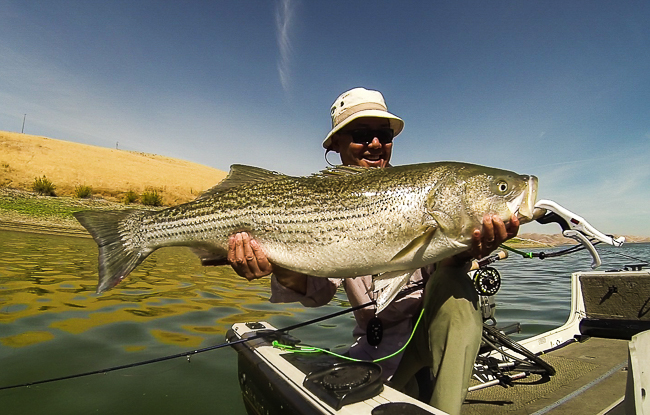
I caught my personal best striper out of San Luis Reservoir today—a 43-inch, 32-pound giant.
I’m thrilled to have finally broken the 30-pound barrier, but the accomplishment comes with a little heartbreak. Despite my best efforts, I couldn’t revive the fish and it died. A 32-pound San Luis striper is probably over ten years old. This fish was born when my kids were still in middle school. It survived droughts, low water years, algae blooms, predators, anglers, and whatever else the reservoir could throw at it.
Unfortunately, it didn’t survive me.
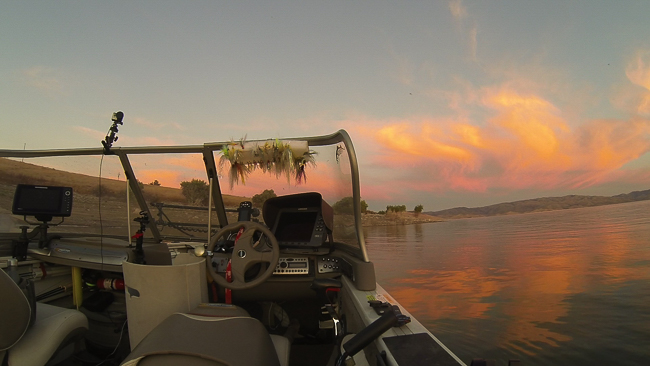
Gina left for New Jersey at 4:00 a.m. this morning to visit family. Since I was already awake to drive her to the airport, I figured I might as well chase a sunrise bite. Vaughn had just reported his best day of the year and the weather forecast looked perfect. In fact, it was almost too perfect. The lake was so calm it looked like someone had accidentally turned the wind off. Vaughn suggested starting at the Bay of Pigs, where he had caught so many fish the day before that his thumbs were reportedly raw. I arrived at the lake around 6:30 and was greeted by one of those San Luis sunrises that makes you forget every skunking you’ve ever endured. The sky glowed orange and blue, baitfish were flickering everywhere, and optimism was running dangerously high.
I started in ten feet of water along the shoreline with a five-weight shad rod, an indicator, and two tiny flies. The shad ignored me with remarkable discipline. Ken Oda had been catching them a week earlier, but apparently word had gotten out. The fish looked at my flies, held a committee meeting, and unanimously voted no. The smaller stripers, however, were more cooperative. I caught dinks by the dozen. After twenty undersized fish, I finally decided that if I wanted to meet their grandfather, I’d better move deeper and throw bigger flies. The dam police were already patrolling when I arrived and remained there the entire day. Apparently, somebody has to protect the dam from dangerous retirees with fly rods.
I switched to a 1/0 Flashtail Clouser on a T-14 head and began working a drop-off that fell from twenty feet into forty. I was marking scattered brush piles and rock piles but no obvious schools of fish. Then the fly simply stopped. I set the hook. At first I thought I had snagged a stump. Then the stump headed for Fresno. The fish immediately made a blistering run of nearly 250 feet, dragging me behind it like I was water skiing without skis. By the pulse of its tail, I knew this was different. Bigger. Much bigger.
I fired up the trolling motor and gave chase. Eventually I got over deeper water and started gaining line. The fish circled lower and lower beneath the boat in those giant spirals that big stripers seem to love. When it finally came close, I grabbed my plastic fish gripper. That’s when I noticed a problem. The fish’s mouth was basically welded shut. I tried prying it open with one hand while holding the rod with the other. The fish responded by leaving again with another eighty feet of line.
Negotiations had broken down. The second time I got it to the boat, it rolled onto its side. I managed to pry its mouth open and clamp the gripper onto its jaw. The fish exploded. My entire arm moved. The gripper nearly flew out of my hand. I reached for its tail but the fish was just far enough away to remain in complete control of the situation. What followed could best be described as organized chaos. I eventually switched to the big Boga Grip. Looking at the fish’s mouth, I had only one thought: “You’re gonna need a bigger Boga.” The lips on that fish were thicker than my fingers. The big boga settled at 32 pounds. Forty-three inches. Personal best.
I pulled the fish onto my lap for a quick hero shot and immediately slid it back into the water. The fight had only lasted five or ten minutes, and I felt pretty confident it would recover. The fish kicked away strongly. I breathed a sigh of relief. Then I heard a splash. I turned around and saw the fish swimming sideways in a slow circle. My stomach sank. I quickly maneuvered over, clipped the Boga back on, and began towing the fish through the water toward deeper water. The area was thick with algae and I figured cleaner water might help. For a while it seemed to be working. I could feel the fish gaining strength. The tail started kicking harder. I released it again. This time it swam away under its own power for about a minute and then surfaced again. I spent the next half hour playing emergency room doctor for a fish older than some of my fly boxes. I towed it. I revived it. I talked to it. I encouraged it. I may have prayed over it. Nothing worked.
Ken Oda, who happens to be both a fisherman and a fish biologist, once told me that once water temperatures approach seventy degrees, reviving really large stripers becomes increasingly difficult. Perhaps the fish had experienced previous barotrauma. Perhaps it was simply exhausted. Whatever the reason, the old warrior couldn’t stay upright. I even found myself wondering whether an EpiPen would work on a striper. That probably tells you how desperate I was getting.
To make matters worse, the revival effort took so long that my cameras looped over the footage of the hookup and fight. The same thing happened a few weeks ago with an eighteen-pounder I caught while fishing with Ed Rea. Apparently my electronics assume no sane person would spend thirty minutes performing CPR on a fish. By early afternoon I accepted reality. The giant wasn’t coming back. Since the fish was far too large for the livewell anyway, I decided to call it a day.
Back at the cleaning station, I performed what can only be described as a fish autopsy. The organs looked healthy. There were several small shad in its stomach. No puncture wounds. No obvious signs of injury other than a fly in the corner of its mouth. As I filleted the fish, I couldn’t help but think of my dad.
Back in the 1960s he’d come home from San Pablo Bay party boats with giant ocean stripers that seemed as big as me. I could almost feel him smiling from heaven knowing that, for once, I actually brought home the meat instead of releasing it. I also knew my 93-year-old mom would be pretty happy to see a freezer full of fresh striper fillets.
The drive home gave me plenty of time to think. About the fish. About luck. About fate. What were the odds that my little fly would pass directly in front of that fish’s face at exactly the right moment on exactly the right morning? For more than a decade that fish had avoided every danger San Luis Reservoir could offer. Then today it met a guy who decided on a last minute trip to the lake. I hope that old fish lived a good life. I hope it ate well, spawned often, and produced enough offspring to keep me entertained for years to come. And if stripers have a heaven, I hope he’s up there right now telling all the other fish about the idiot in the boat who spent thirty minutes trying to save him after catching him. Because honestly, after today, I think we’ve both got a pretty good story.


Woooo Hooo Meng – WTG! Glad to see you land your PB, well deserved. Always a bummer to lose a great old gal like that, but I know she was in good hands with you… just wasn’t meant to be this time.
Meng:
Congratulations on the BIG ONE! Nice fish. Bummer you couldn’t revive it, but that’s the way it goes. Don’t beat yourself up about it.
Hey Meng,
Congrats on your new pb. I’ve had fish die on me before when I caught them in 25 ft of water or deeper. I believe this is because their swim ladders inflate. In your clips, it looked like the fish had plenty of energy but couldn’t get back down to depth because the inflated balloon in its stomach.
With that said, I know some guys out at the reservoir (mostly trollers) use a device called the Seaqualizer. This thing returns fish back to the depths and releases them once they hit say 30ft or 60ft. It’s much better than venting the fish as you aren’t puncturing the bladder.
My brother just got a boat so no more float tubes. I’ll be getting him a seaqualizer as a congrats on the new purchase.
If this site doesn’t work, google “seaqualizer” and check out the striper model. http://seaqualizer.com/products/shallow-water-striper-seaqualizer-30-50-70ft.html
Just started reading your blog a couple months ago and enjoy it. In your last post I sensed some remorse over killing the big one. It happens. Also how many thousands of pounds of fish have you released over the years and maybe that fish was one of those! Cheers to you!
Mike
F/V P ALICE