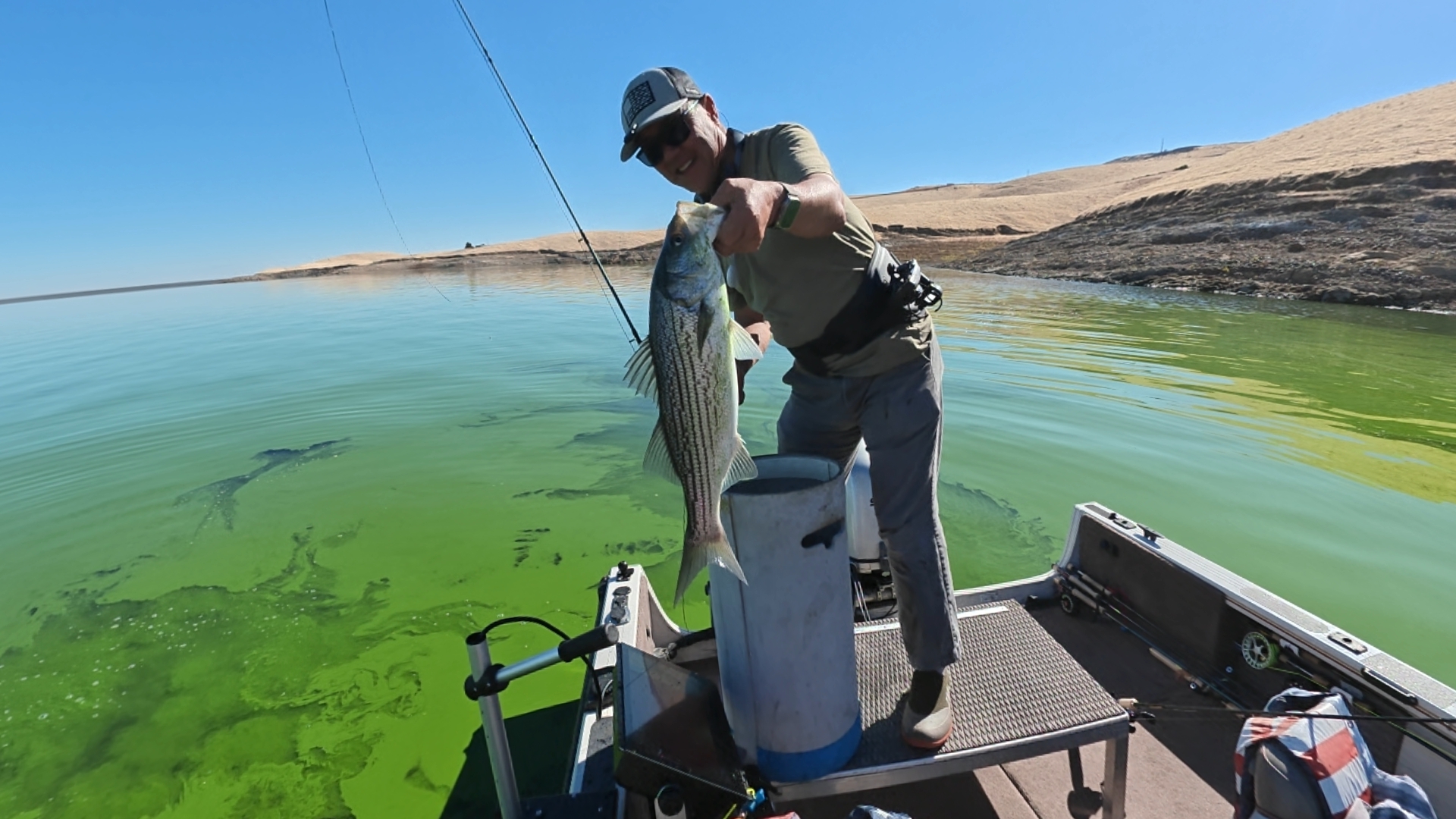
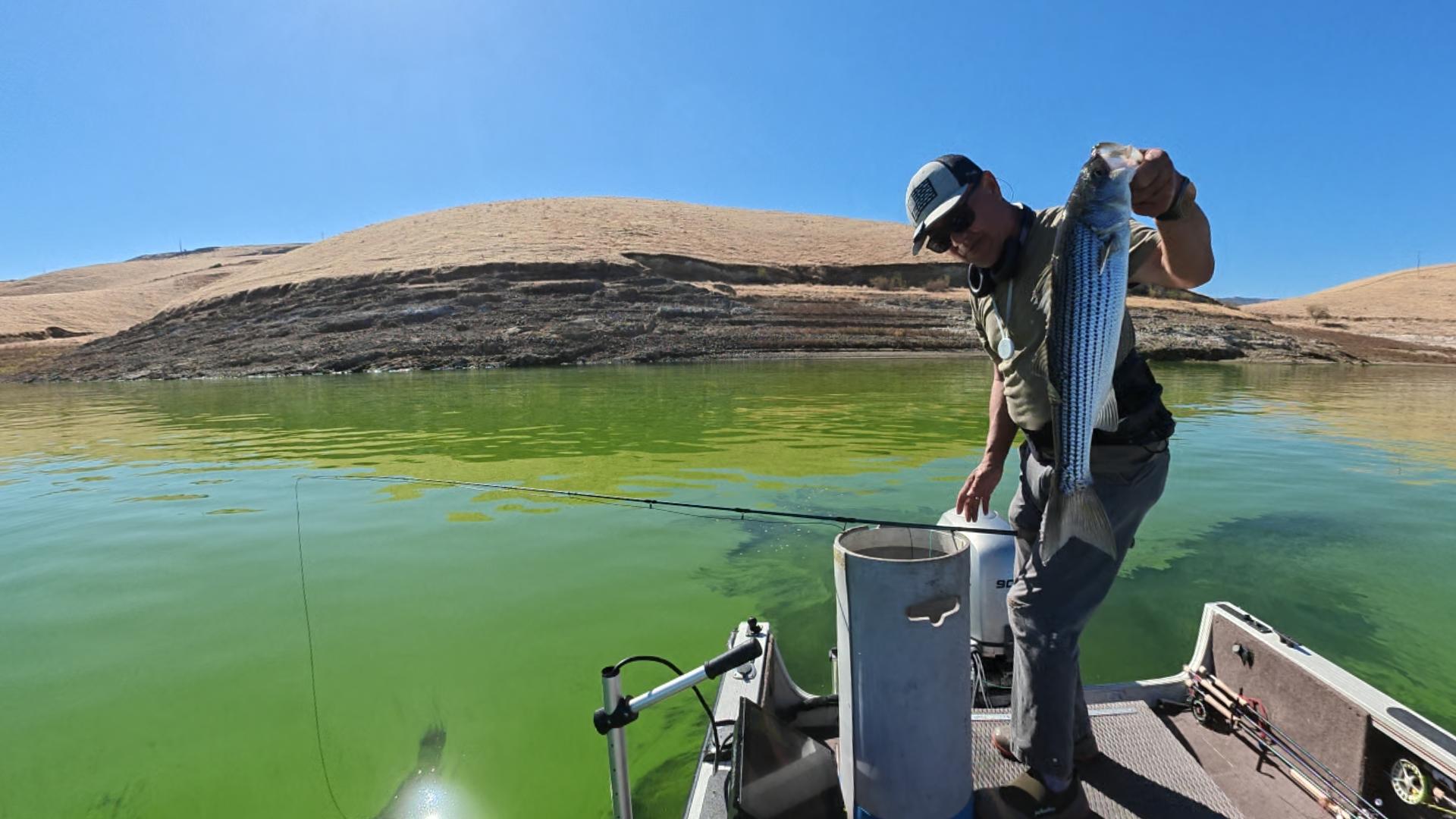
Another day of trying to outsmart striped bass at San Luis Reservoir. Two days ago, I went to O’Neill Forebay to test my new Garmin LiveScope 2 system. I caught over twenty striped bass, most of which were approximately the size of the bait people use in Alaska. A couple barely made eighteen inches and ended up in my kitchen. It was fun, I suppose, in the same way that catching bluegills is fun after fighting a thirty-inch steelhead.
I needed something bigger.
So today I headed to San Luis Reservoir, armed with my new Garmin electronics, several decades of fishing experience, and the irrational confidence that comes from spending thousands of dollars on technology.
Surely the fish couldn’t hide from me now.
The Dead Sea of San Luis
It was October 17, and the temperature was 91 degrees. Ninety-one! Apparently, somebody forgot to tell California that summer was over. The lake was unusually calm, with more algae than I could remember seeing this time of year. Normally, algae can be a good thing, particularly when a bloom first develops. But today the lake looked suspiciously like it was trying to grow its own lawn. I started checking my usual haunts.
Bay of Pigs. Nothing.
The dam. Almost nothing.
Trash Racks. Nothing.
Rocky Points around Basalt. Nothing.
Monument. Nothing.
Las Piedras. More nothing.
I was beginning to wonder whether the striped bass had received an evacuation notice that I hadn’t.
The Trash Racks were especially disappointing. There were several boats parked around them, and I wanted to explore the other side with my new LiveScope. I scanned the accessible face and saw beautiful underwater structure. Not a fish in sight. Now, having spent a small fortune on a new Garmin system, I naturally assumed the problem was the electronics. Perhaps the gain was too low. Perhaps the color gain needed adjusting. Maybe the fish were being electronically erased by some mysterious setting.
I fiddled with everything. The structure looked magnificent. The screen was bright. The resolution was terrific. Still no fish. It’s remarkable how much money you can spend to see absolutely nothing in high definition.
Three Trees and a Little Luck
Eventually, I headed toward a cove I call Three Trees, a place I hadn’t seriously fished in probably ten years.
Years ago, when the lake was higher, that cove held fish. But with fluctuating water levels, it had become pretty barren, and I’d mostly forgotten about it. Today, with the water coming up, I decided to give it another look. And there they were. Stripers busting bait on the surface! Of course, the moment I saw them, I did what every experienced striper fisherman does. I chased them. And, as usual, by the time I arrived, they were gone.
I chased another boil. Gone. Another. Gone.
This was beginning to resemble a game of Whac-A-Mole, except the moles had sonar, fins, and a considerably better understanding of the game. Then I remembered something. I had just spent a ridiculous amount of money on a machine designed to find fish I couldn’t see. Maybe I should actually use it. Instead of chasing the surface boils, I stopped the boat and started scanning with the LiveScope. And there they were! Schools of stripers swimming around beneath the surface, still in the general area where they’d been feeding. The fish hadn’t disappeared. They’d simply gone underwater. Imagine that. I could actually see the schools moving, aim my casts toward them, and watch what was happening. And suddenly, I was catching fish.
Not those little Forebay stripers, either. These were chunky, hard-pulling fish in the twenty-two- to twenty-four-inch range. The kind that bend an eight-weight rod and remind you why you got into this ridiculous sport in the first place.
I landed two nice fish from those schools, adding to one I’d caught earlier along the dam. Three fish for the day. A limit. And according to the ranger at the ramp, most of the other fishermen hadn’t done particularly well. For once, I felt pretty clever. Of course, it’s entirely possible that the fish were just feeling sorry for me.
A Fish Finder That Actually Finds Fish
I’ve been using LiveScope since the first generation, and this is my third version of the technology. The new LVS44 and sixteen-inch Garmin display are impressive. But today was the first time I really appreciated what the upgrade could do. I could find schools that had stopped feeding on the surface, follow their movements, and cast directly to them. Without LiveScope, I doubt I would have caught those two fish. There’s an old argument that using forward-facing sonar is cheating. I have a slightly different opinion. Anyone who thinks LiveScope is cheating doesn’t understand the difference between finding fish and catching fish. Today I spent hours finding places where there weren’t any fish. The Garmin was exceptionally good at that. But when I finally found them, it helped me catch them. Which, considering what the system cost, was a considerable relief.
The Mystery of the Fat, Hungry Stripers
When I cleaned the fish, I noticed something interesting. They were fat, healthy stripers, but their stomachs were completely empty. Not a single baitfish. Here we had unusually warm October weather, lots of algae, changing water levels, and stripers that looked well-fed but apparently hadn’t eaten recently. San Luis is full of these little mysteries.
Water gets pumped up from the Forebay, the lake level changes, temperatures fluctuate, baitfish move, and the stripers seem to change their minds about where they want to live every twenty-four hours. One day you can catch fish until your arms hurt. The next day, in exactly the same spot, you’d swear the lake had been drained of every living creature. I’ve been fishing San Luis most of my life, and I still don’t completely understand it. Which is probably why I keep coming back.
The Grass Is Always Greener, Especially in Alaska
I’ll admit something. I’m a little jealous of my fishing friends. My cousin lives up near Chico, with the Feather River and its steelhead practically in his backyard. My buddy in Alaska is having the fishing season of his life, catching salmon and trout that would make most fishermen consider moving north permanently.
Meanwhile, I’m driving around San Luis Reservoir in ninety-one-degree October heat, staring at algae and trying to figure out why my expensive electronics aren’t showing any fish. It’s enough to give a fisherman an inferiority complex. But then I think about what I have. San Luis is a huge lake. I can launch my boat, head into a quiet cove, and spend hours without seeing another person. I can fish it whenever I want. Twice a week if I feel like it. Sometimes more. I know its coves, points, underwater structure, and moods. I’ve watched the water rise and fall for decades. I’ve caught some of the biggest striped bass of my life there. It’s my home water. And there’s something special about having a place like that. A place that can still surprise you after a lifetime of fishing it. A place where you can be completely alone with your thoughts, your fly rod, and several thousand dollars’ worth of electronic equipment telling you that there are no fish. A Pretty Good Day After All
So today I caught three nice stripers, explored an old cove I’d neglected for a decade, and finally proved to myself that my latest Garmin upgrade was worth the investment. More importantly, I got to pull on some fish that pulled back. After Kodiak, I needed that. I may not have the Feather River in my backyard or an Alaskan salmon stream down the road, but I’ve got San Luis Reservoir. And after all these years, it still has a few secrets left. I suppose that’s what keeps me fishing. Besides, if I caught fish every time I went out, I’d have absolutely no excuse to buy more equipment.
And that would be a tragedy.