Two days of incredible stillwater fly fishing, freezing weather, and a few camping upgrades that made all the difference
November 2026 | Bidwell Ranch, Northern California
Sometimes the best fishing trips are the ones where everything doesn’t go according to plan. Our recent trip to Bidwell Ponds, near Baum Lake in Northern California, turned out to be one of those memorable adventures. We encountered freezing temperatures, rain, snow, unexpected camping challenges, and some of the best midge fishing I’ve experienced in years. Along the way, I learned a few things about fishing tiny chironomids that will probably change how I approach stillwater fly fishing in the future.
Gina and I headed north in our camper van for a few days of fishing and relaxation at Bidwell Ranch, a Wilderness Unlimited private fishing property near Baum Lake. We stopped for a late lunch at Black Bear Diner around two in the afternoon, which turned out to be a good decision because we were too full to bother cooking dinner that evening. Our first surprise came when we contacted Corey, who manages the property. He had mentioned previously that he sold firewood, so rather than bringing our own, we’d planned to purchase some from him. Unfortunately, Corey was out of town for three days. That left us without firewood with really cold weather ahead, but fortunately, I’d brought along our Howler R3 propane fire pit. Unfortunatly I only brought a 5lb tank of propane which lasted us about 4 hours the first night. As it turned out, that was probably better than having a traditional campfire. but we needed more propane for the next two days.
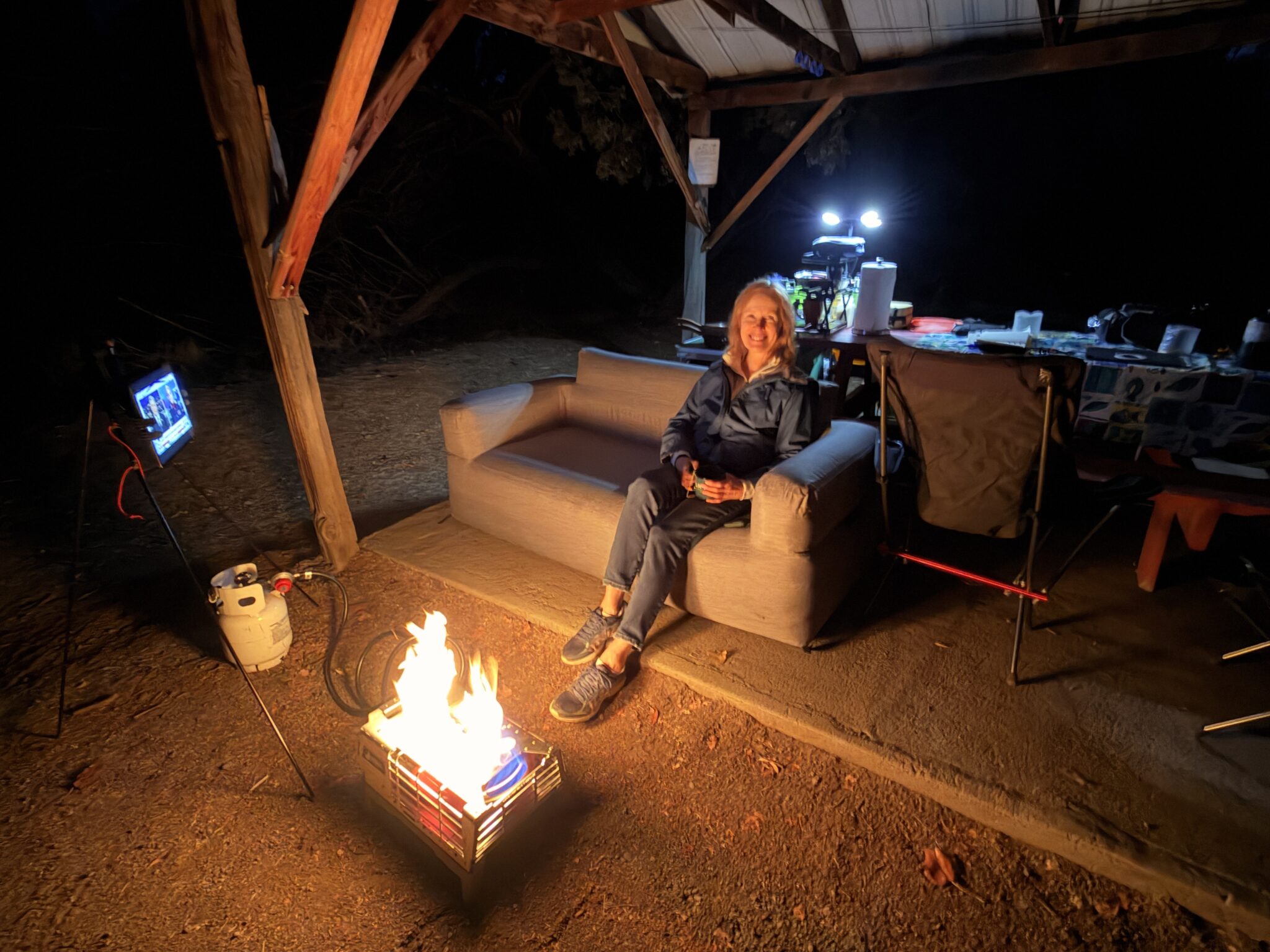
We could position the propane fire pit close to our chairs and an incredibly comfortable blow up sofa, control the heat, and turn it on and off instantly. There was no smoke or toxic fumes, no wet wood to contend with, and no struggling to light a fire in the rain. It would become one of our favorite pieces of camping equipment and it was the perfect weekend to use it with snow on the forecast.
 f
When we arrived at Pond 2, two older fishermen were just leaving. One was an elderly Japanese gentleman. They seemed to be in a hurry, so I didn’t have an opportunity to ask how the fishing had been. But as we began setting up camp, I couldn’t help noticing something extraordinary. Fish were rising everywhere. Despite the cold, overcast weather, the pond was alive with feeding trout. I quickly assembled my float tube and managed to get in a couple of hours of fishing before darkness. I caught a couple of trout, but more importantly, I realized we had arrived during an incredible midge hatch.
This was going to be interesting.
Camping Comfortably in Freezing Weather
We selected the inside campsite at Pond 2, one of only two campsites on the pond. Unfortunately, we discovered that the bathrooms and showers were locked for the winter. Corey explained that once temperatures dropped below freezing, the plumbing had to be shut down to prevent the pipes from freezing. That was disappointing because we’d enjoyed the heated showers on previous visits. Our camper has its own hot-water shower, but using the outdoor shower enclosure in freezing temperatures wasn’t particularly appealing. So we decided to skip showers for a couple of days.
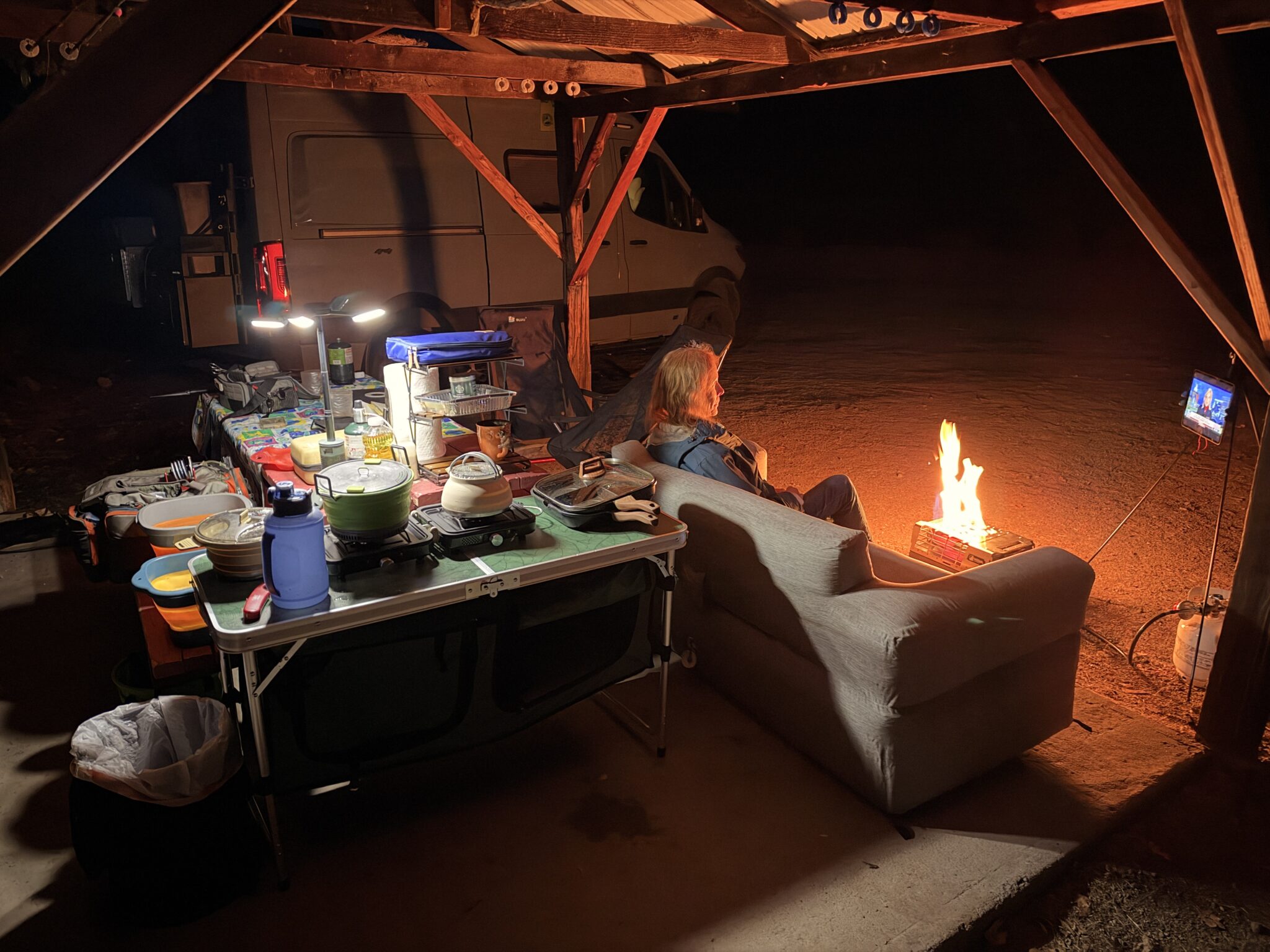
Fortunately, we’d made several upgrades to our camping setup. The biggest improvement was an inflatable sofa. Instead of sitting in individual camping chairs, we placed the sofa beneath the roofed picnic shelter, facing our propane fire pit and Starlink powered TV. I felt like being in our living room, but located in a freezer. It was surprisingly comfortable. And we were all alone on a pond full of rising fish and bright stars overhead in the crisp cold mountain air.
Starlink has completely changed our camping experience. Even in a remote location like Bidwell Ranch, we could stream television just as easily as we could at home. I took care of some office issues and did some remote computer support. I had access to AI and worked through some problems from remote. We watched Oregon bet Northwestern, and watched the midterm election coverage Our camper’s diesel heater kept the interior warm throughout the night so we had a warn place we could hold out overnight. I still love how cozy the van is and so does Gina as we imagined bringing grandkids up here to camp with us.
I’d also reorganized our outdoor kitchen, adding another table for our double-burner stove. That made cooking considerably more convenient. I added a dish washing station and a double propane stove top. We were definitely stepping up our camping game.
Saturday: An Extraordinary Midge Hatch
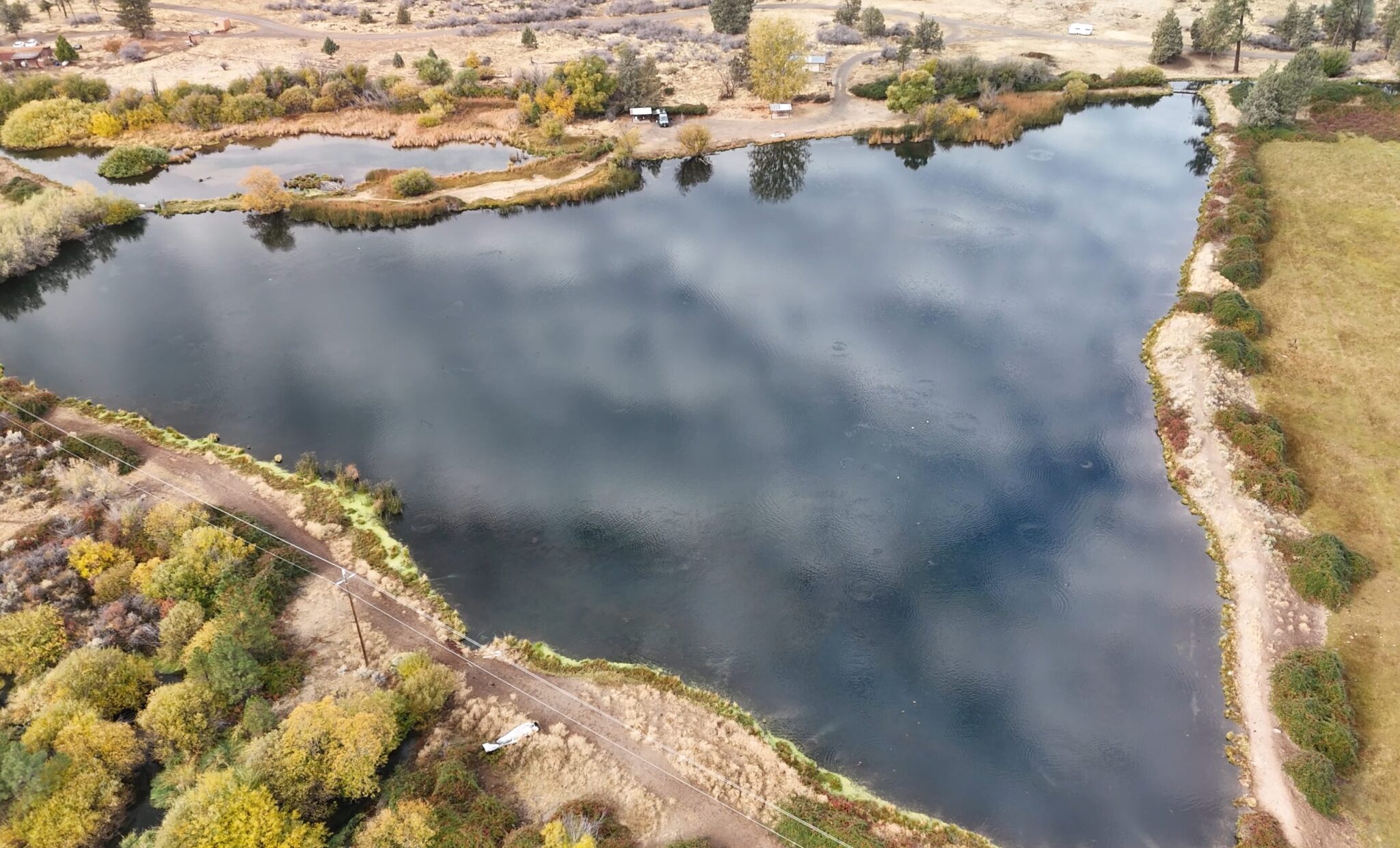
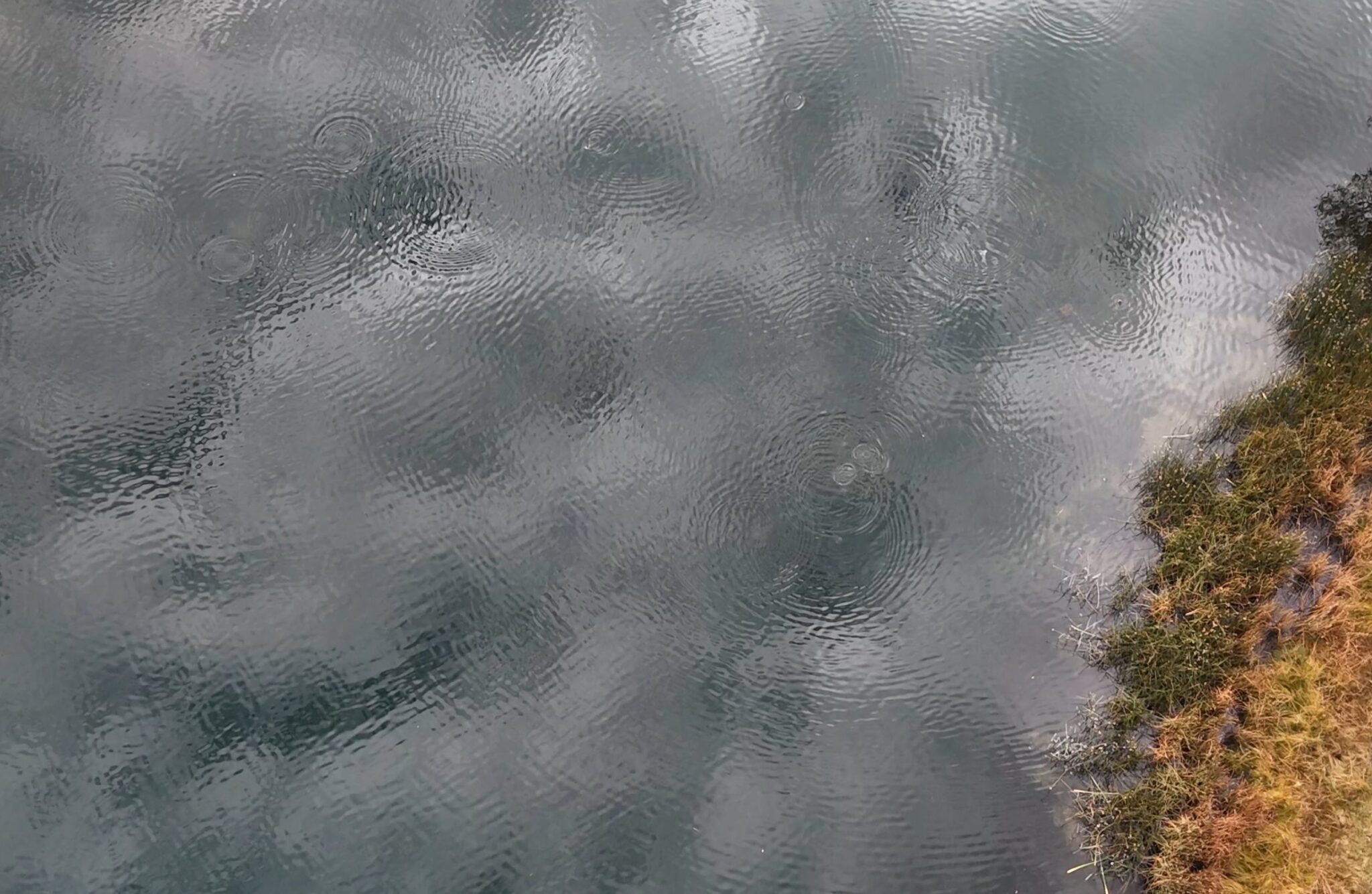
Saturday morning was cold, cloudy, and overcast. It was the worst of the weather days with snow and rain predicted around 1am to 5pm. I was on the water around seven while Gina enjoyed sleeping in. Almost immediately, I noticed tremendous numbers of trout feeding near the surface. There were several distinct types of rises.
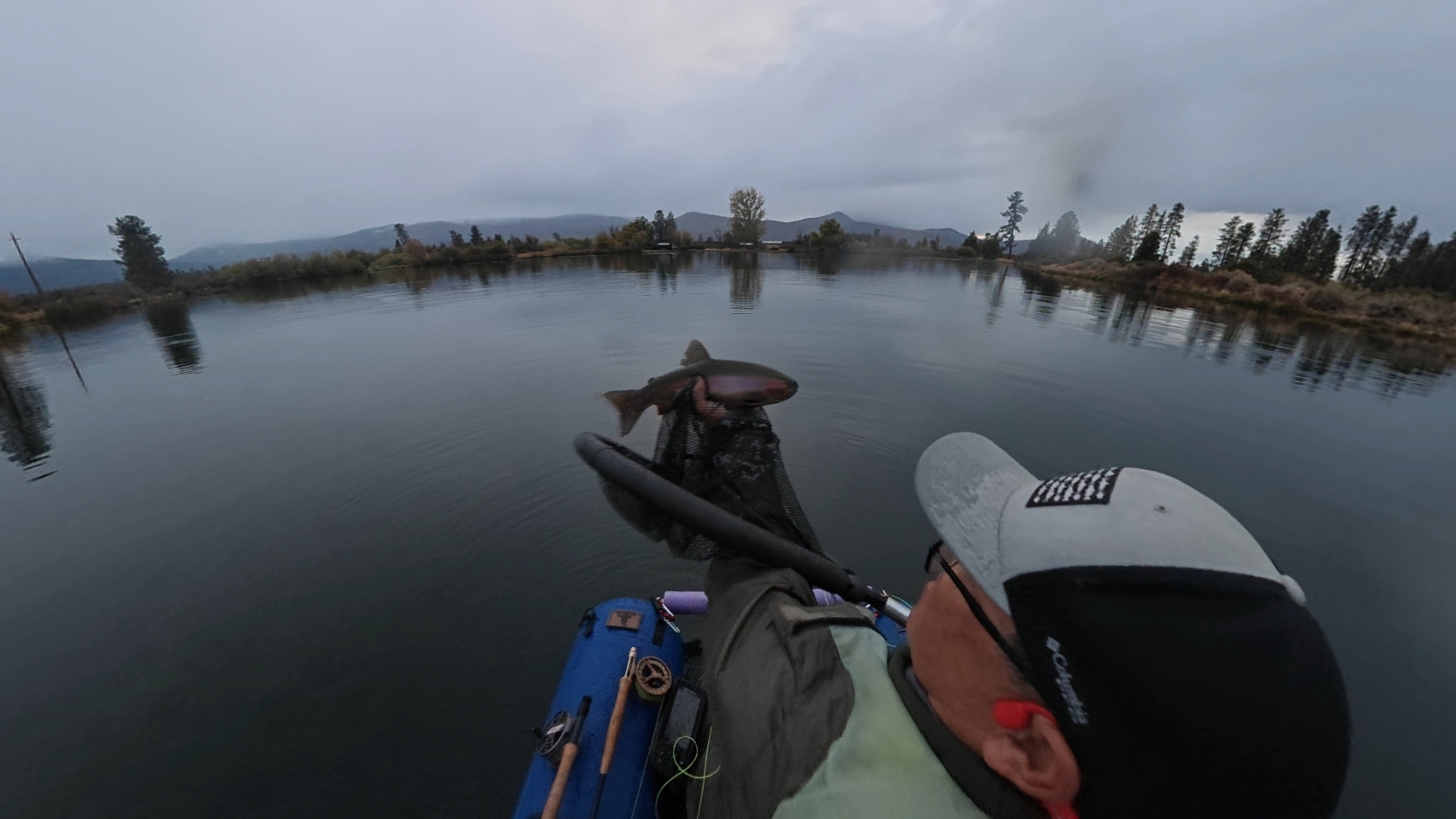
Some fish were making subtle dimples, barely disturbing the surface. Others were pushing bulges of water as they chased emerging insects just beneath the film. Occasionally, a trout would actually stick its nose out of the water to intercept an adult midge. I could see tiny midges on the surface, and sometimes I watched trout chase emerging insects all the way up, only to have the insects fly away just before the fish could eat them. It was fascinating to watch fish feeding between raindrops on bugs that were smaller than my smallest flies. The fish were clearly feeding on chironomids, but figuring out how to catch them consistently was another matter.
I started experimenting with several presentations.
First, I tried tiny Griffith’s Gnats, using a small piece of wool as a strike indicator to help locate the nearly invisible flies. Then I switched to small unweighted chironomid pupae suspended about four feet beneath an indicator. Both methods produced fish especial if subtly moving, but considering how many trout were rising, I wasn’t particularly satisfied with my results.
Then something interesting happened. The Japanese Angler and His Mysterious Fly. The same two gentlemen who had been leaving the pond when we arrived returned that morning. The elderly Japanese angler launched his float tube shortly after I had and began fishing the opposite side of the pond. Around ten o’clock, he returned to shore and asked how I was doing. I told him I’d caught a couple of small trout but was having difficulty consistently fooling all those rising fish. He showed me the fly he’d been using. I could hardly believe what I was looking at. It looked almost like a bare hook. Whatever materials had originally been tied onto it had been largely destroyed. He explained that he was fishing the fly on an intermediate sinking line, retrieving it with small sharp strips for a “reaction bite ” . I asked how many trout he’d caught. Eight that morning. Then he told me that the previous day he’d caught more fish than he could count, all on the same fly. I was astonished. He generously offered me the battered fly, but I was more interested in understanding what it had originally looked like. When I asked, he produced another example. It was an unusual, very slender, unweighted fly. What struck me most was its sparse construction. There was very little material on the hook. I’d heard before that extremely skinny flies often outperform thicker, more heavily dressed patterns when trout are feeding on small aquatic insects and here was another example.
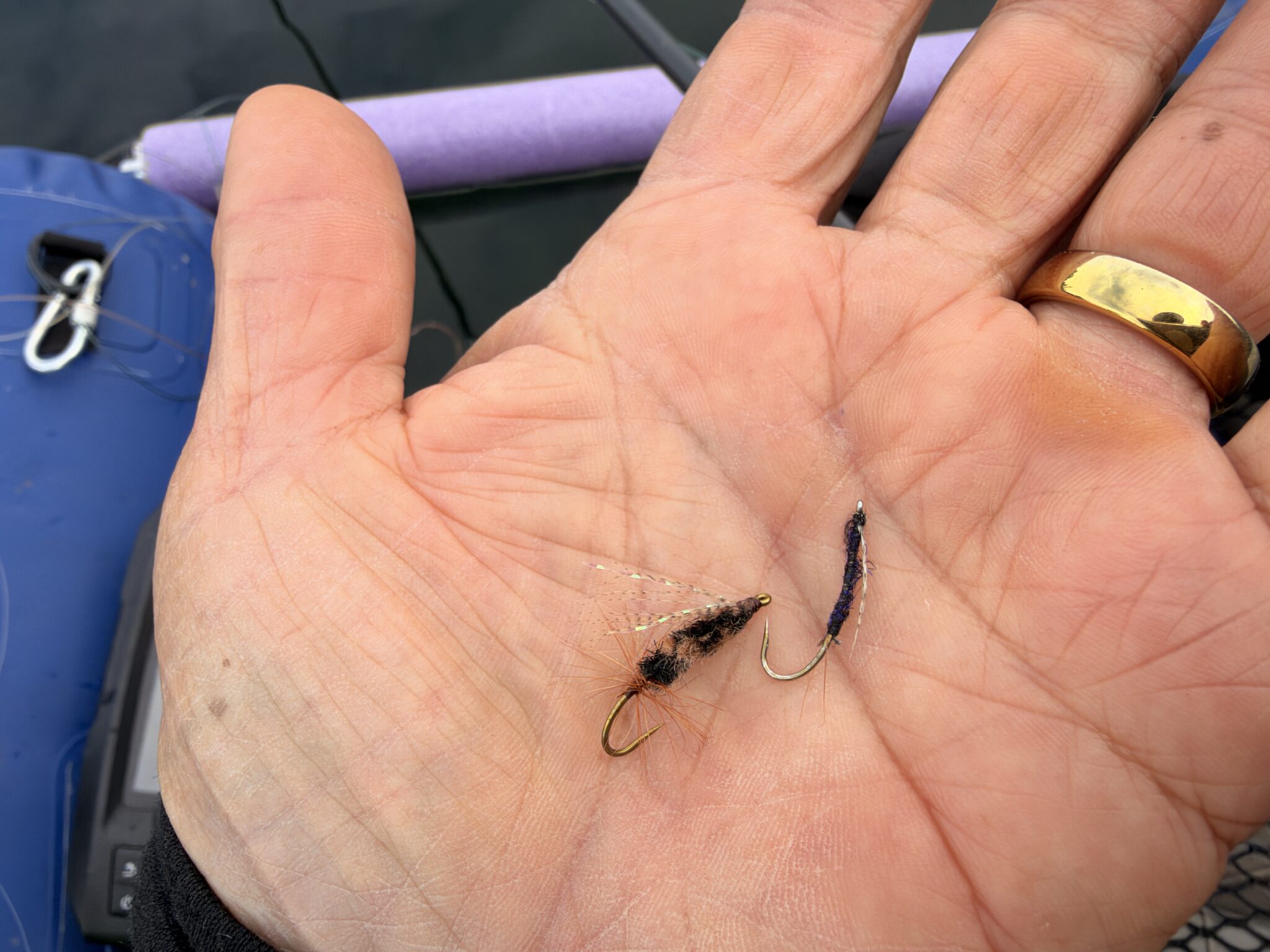
But perhaps the most important detail was his presentation. He was using a Denny RIckard Hover Line line with an unweighted fly. When he stripped the fly, it moved through the water. When he paused, the fly didn’t immediately plunge toward the bottom like a weighted nymph. Instead, it remained relatively suspended, following the gradual descent of the line. That gave me an idea.
Rediscovering the Hover Line
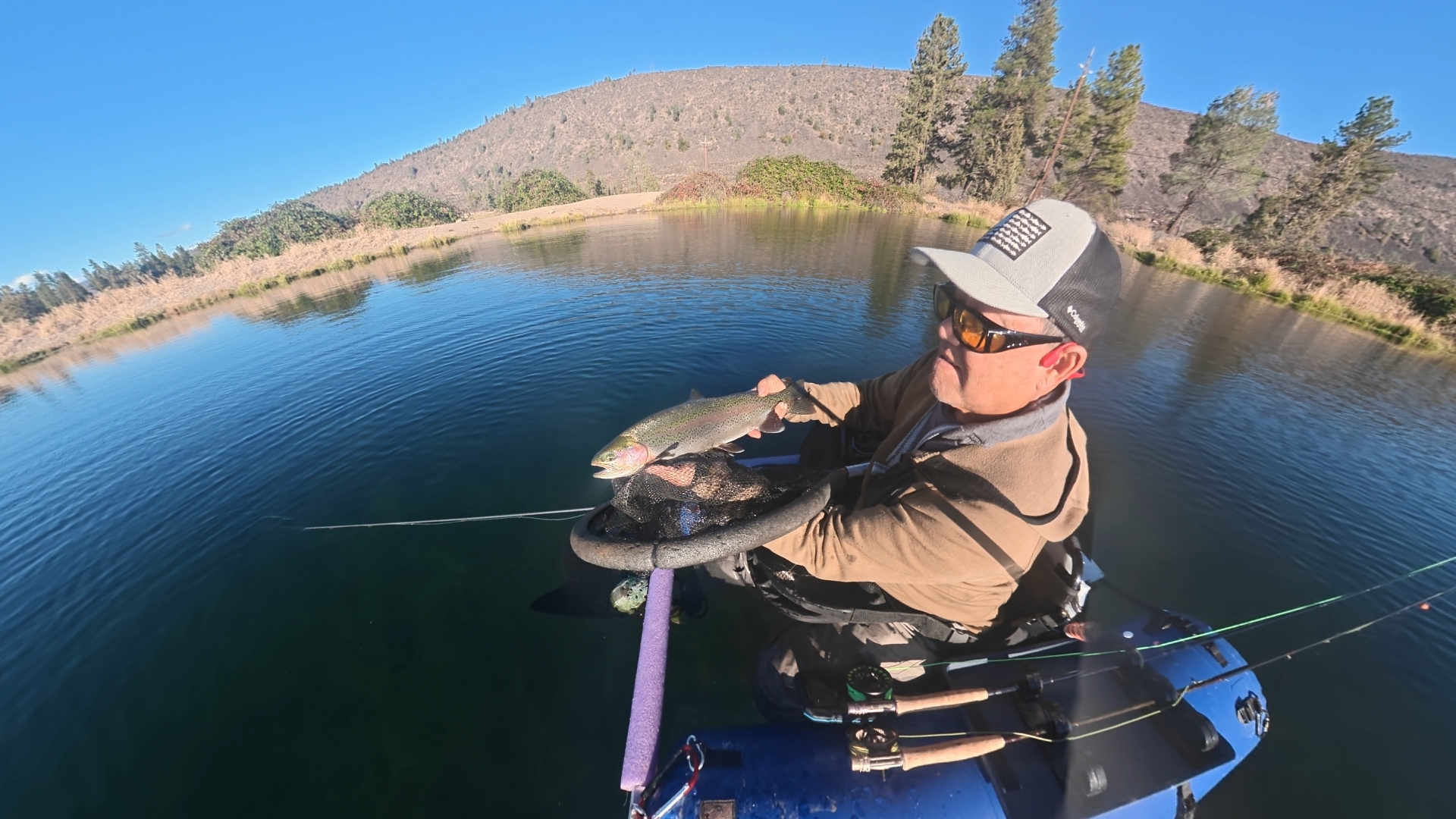
I’ve had considerable success in previous years stripping Prince Nymphs on intermediate lines. I happened to. have that exact fly line on a 5wgt Helios. I had brought a hover line, which sinks extremely slowly, and decided to experiment with a similar approach. Rather than trying to duplicate the Japanese angler’s unusual pattern, I tied on an olive Cowboy Leech. The Cowboy Leech is a small pattern, approximately an inch and a half long, with a squirrel-hair wing, a Mylar body, and a bead head. The olive color closely resembles the aquatic vegetation in the pond, while the Mylar provides a little flash. I began retrieving it with short sharp strips on the hover line. The results were immediate.
Suddenly, I was catching trout more consistently that throwing chironomids on an indicator. The fish were particularly interested in the fly when I paused the retrieve. That was an important observation. The trout weren’t necessarily chasing the fly aggressively during the strip. They frequently took it as it slowed or momentarily hovered. The combination of subtle movement, a little flash, and a slow-sinking presentation was remarkably effective.
I continued alternating between three techniques: tiny Griffith’s Gnats on the surface, chironomids beneath an indicator, and the Cowboy Leech on the hover line. By noon, I’d caught over a dozen fish alternating between indicator fishing and stripping. And the fishing remained excellent. By 1:00. the rain started getting heavy so I went in and took Gina to Burney to solve our firewood problem.
We hit up Ace Hardware, Safeway, The Pit River Casino Mini Market, and blanked out. All the places we went wanted to trade a tank for a tank. Finally we found Speedway Gas Station open 24/7 with tons of propane full tanks and trade ins. We had enough propane for 6 hours of heat and that was enough for the two more days we had. Problem solved.
Back at camp by 3pm, Gina settled into the cozy camper to work on her scrapbooking while I returned to the pond. The fishing was so good that I stayed out until dark. Apparently, Gina was beginning to wonder whether I’d drowned somewhere in the pond. I finally returned, cold but happy.
That evening, I cooked rosemary-marinated steaks from Trader Joe’s, accompanied by salad and steamed rice. After dinner, we relaxed on our inflatable sofa in front of the propane fire pit and started watching The Terminal List. while it rained and snowed on us. Even so with the fire warming us, and the television streaming perfectly over Starlink, it was remarkably comfortable. Eventually, we retreated into our diesel-heated camper for the night.
Sunday: Ice, Sunshine, and More Trout
Sunday morning was even colder. The skies had cleared, but everything outside was frozen. There was ice on the ground, and my float tube was covered with frost. I made myself a large pot of coffee and waited for the float tube to thaw enough to use. Once I got on the water, the fishing was excellent again. By noon, I’d caught another dozen trout.
Interestingly, the conditions were quite different from Saturday. Saturday had been overcast, with occasional rain, snow, and a light breeze. Sunday was sunny and colder. Although the fishing was still productive, I felt that Saturday’s overcast conditions had produced the more impressive midge activity. The cloudy weather seemed to encourage trout to feed actively near the surface throughout much of the day. On Sunday, I also began exploring the opposite bank. I’d spent so much time catching trout along the near shoreline that I hadn’t felt any need to move. But I discovered that the opposite bank appeared to hold some larger fish. I managed 4 fish around 18 inches that fought on my 4 wgt like the steelhead I caught in Kodiak on Spey, It’s as if these fish in pond 2 had never been hooked before. The fish were all fat and dark in there spawning colors.
What the Trout Were Eating
One of the most revealing parts of the trip came when I used my stomach pump to examine what several trout had been eating. Their stomach contents were packed with tiny chironomids. These were extremely small insects, many corresponding to fly sizes around 20 to 24. It confirmed something I’d suspected throughout the trip. The trout were feeding on midges almost continuously, even when they weren’t visibly rising. The pond has several different feeding environments though much of the water is shallow, perhaps only three feet deep.
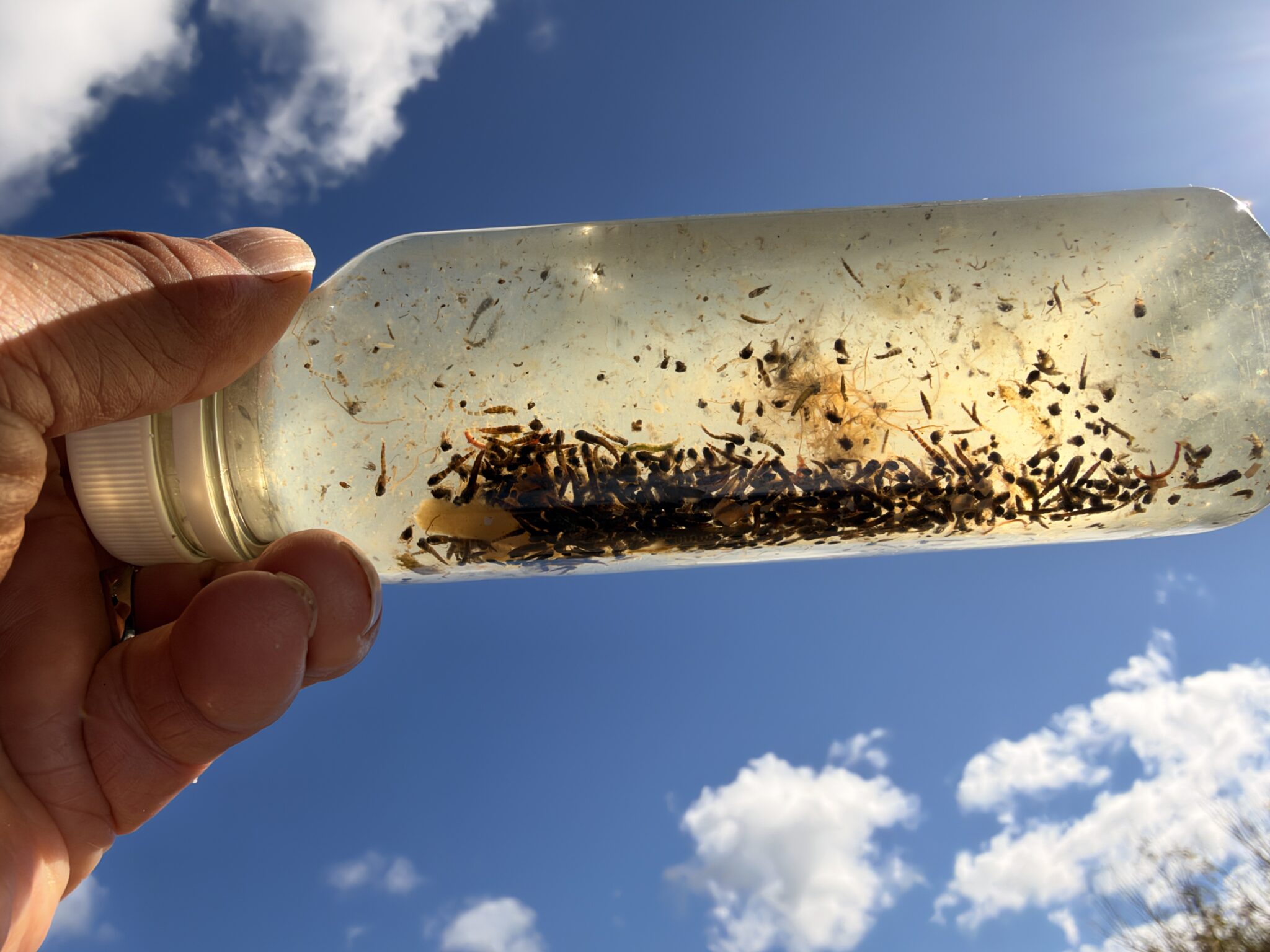
In these areas, trout frequently feed near the surface, intercepting emerging midges as they ascend through the water column. Other areas are considerably deeper at 8 ft. The entire lake is carpeted by weeds much like Baum Lake. Artesian Springs of Lost creek feed the lakes with cold clear water all year.
When surface activity slowed, trout in these deeper areas continued feeding on chironomids near the bottom. I found that suspending chironomids beneath an indicator could still produce fish even when the surface appeared quiet. That observation reinforced the importance of understanding where trout are feeding rather than simply looking for rises. A wise angler once told me to fish to the wind. I think when there is a ripple on the water, your flies move more and the fish get less wary of you presence. I also found that I rarely needed to fish tippet finer than 5X except in very still conditions.
Three Different Feeding Zones
By the end of the trip, I’d developed a clearer understanding of how I wanted to approach Bidwell Ponds in the future. There were really three primary feeding situations.
Surface feeding: Trout taking adult midges or insects trapped in the surface film. These fish often produced distinct dimples or exposed their noses.
Emerging midges: Trout intercepting ascending pupae just beneath the surface. These fish frequently created subtle bulges, swirls, or disturbances without actually breaking the surface.
Deep chironomid feeding: Trout feeding on pupae near the bottom, often without producing any visible surface activity.
Each situation required a different presentation and flies. And sometimes several types of feeding were occurring simultaneously in different parts of the pond. That’s what made the fishing so interesting. Rethinking My Midge Fly Boxe, This trip convinced me that I need to reorganize my stillwater midge collection. Rather than keeping all my small flies together, I want to build specialized boxes based on how trout are feeding. My first box will contain tiny adult midges and surface patterns, including Griffith’s Gnats and midge clusters. The second will focus on emergers and ascending pupae, especially slender patterns in sizes 20 and 24. The third will contain deeper-water chironomids designed for fishing beneath indicators. And the fourth will be dedicated entirely to stripping flies. I’ll include traditional Prince Nymphs, olive Cowboy Leeches, Soccer Moms, small leech patterns, and other sparse flies with subtle flash. I’ll also experiment with weighted and unweighted versions.
The Japanese angler’s mysterious fly reminded me that complicated patterns aren’t always necessary. Sometimes a tiny, sparsely dressed fly presented at exactly the right depth and speed can be more effective than something elaborate. And the success of my Cowboy Leech reinforced another important lesson. The pause can be just as important as the retrieve. When fish consistently strike as the fly slows, the ability to keep it suspended in the feeding zone becomes critical. That’s where hover lines and lightly weighted or unweighted patterns really shine.
One Final Evening
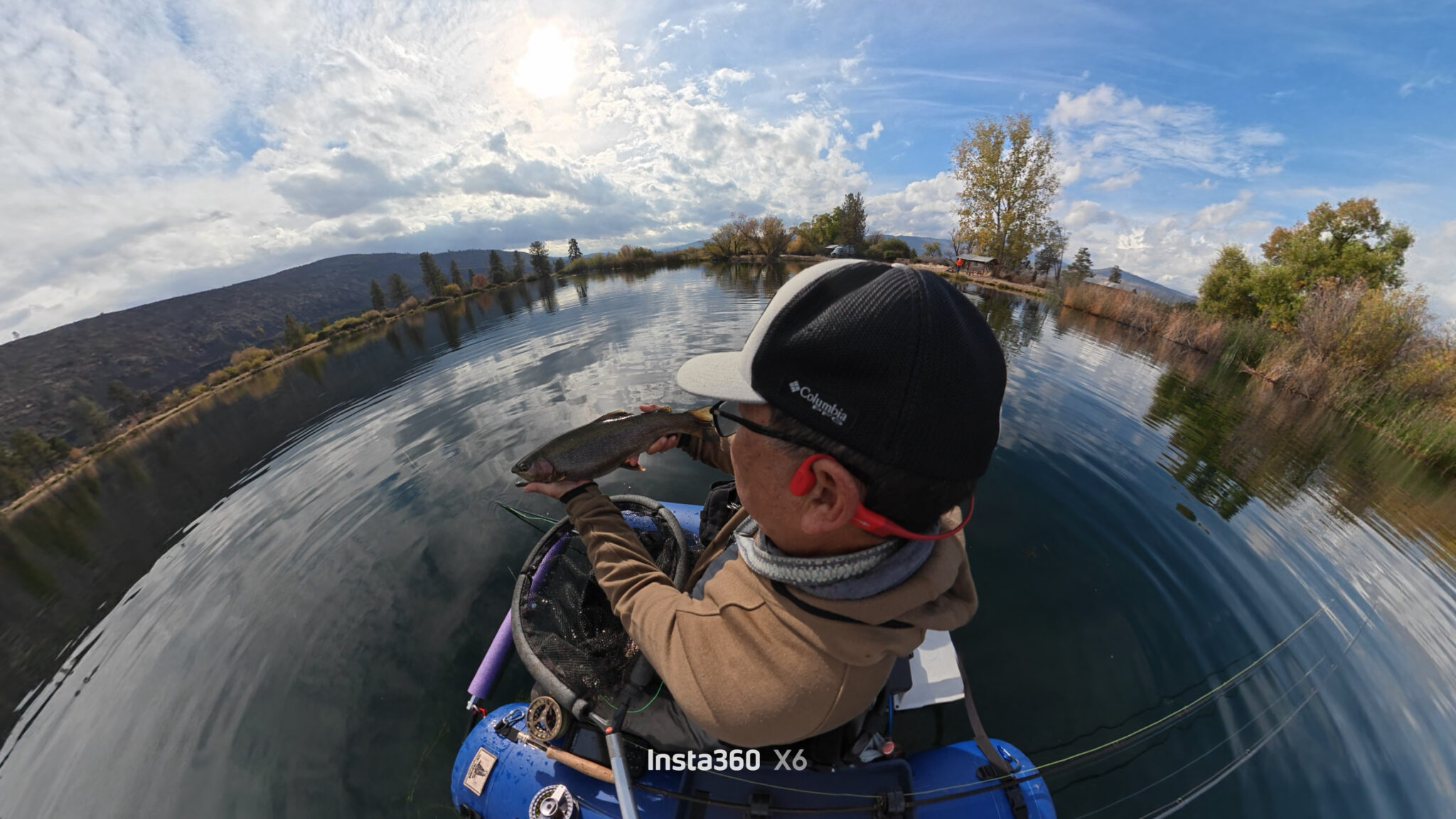
Sunday evening, after another productive day on the water, I returned to camp and prepared a dinner of Tonkotsu Ramen with fresh Wagyu slices, spiced egg, tripe and Bok Choy. Hot Ramen meals are perfect after spending a cold day floating around the pond. We spent another evening relaxing on our inflatable sofa, enjoying the propane fire pit and watching television.
Outside, temperatures were dropping below freezing again. Inside our camper, the diesel heater kept everything comfortable. We were essentially enjoying the comforts of home in the middle of a remote fishing property. Just a little colder.
Heading Home
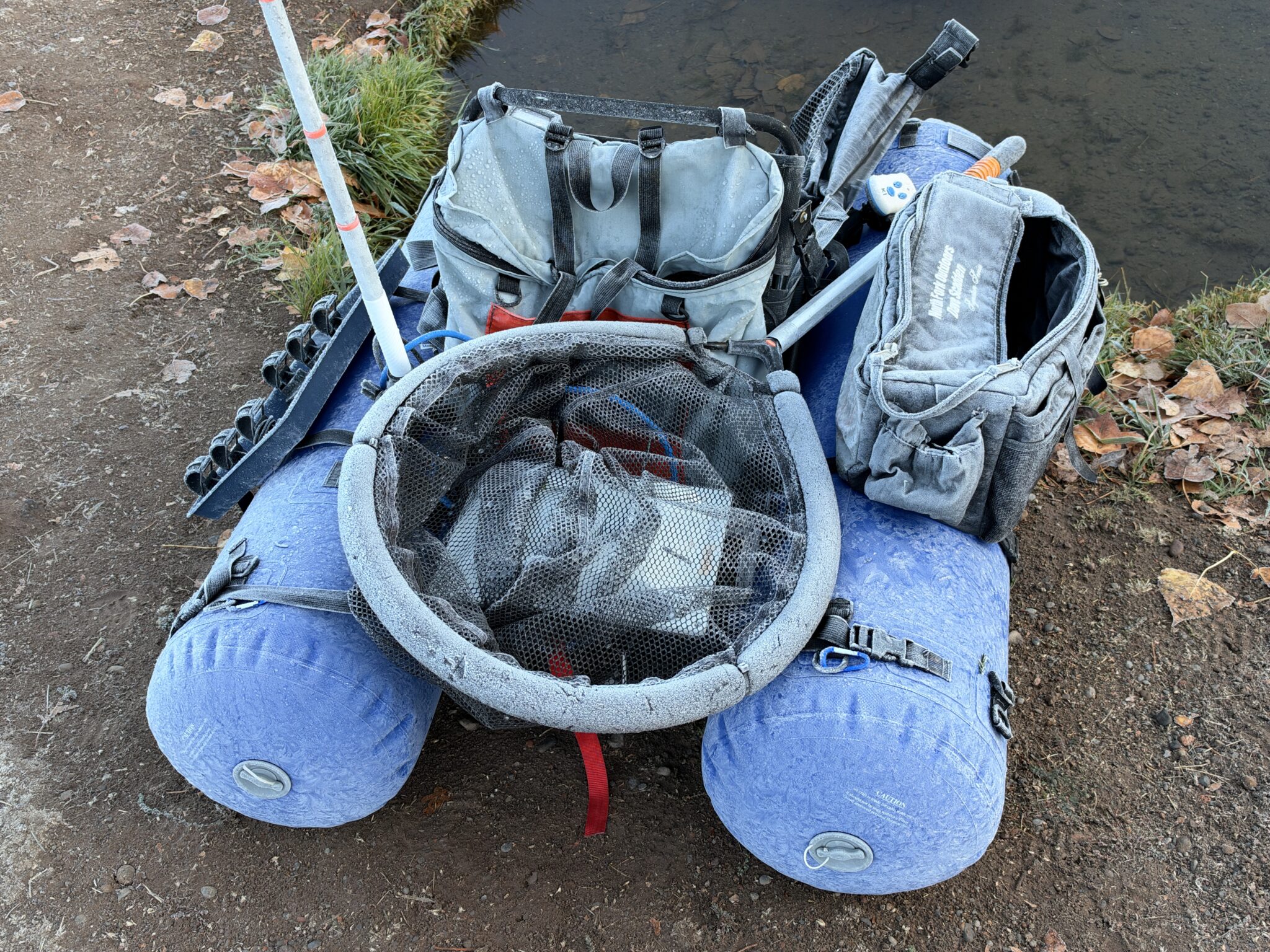
Monday morning was bitterly cold. I considered fishing for a few more hours in the float tube, but ultimately decided to pack up and head home noticing that the tube was froze to a puddle on the ground. Daylight saving had pushed the clocks back an hour and I figured we have to leave by 10am if we wanted to eat lunch at the Black Bear Diner and make it home before rush hour.
I listened to another Audio Book on the way home – Book 6 of the Bobiverse Series by Dennis E. Taylor. A great series of SciFI books about a self replicating AI.
It had been a wonderful trip. We’d caught plenty of trout, enjoyed some excellent meals, and discovered several ways to make our camping setup more comfortable and alone in our own private Idaho. But for me, the most memorable part was the fishing. Watching hundreds of trout feed on tiny midges in freezing weather was an extraordinary experience. And meeting that Japanese angler, seeing his nearly bare fly, and rediscovering the effectiveness of slowly stripping flies on a hover line gave me plenty to think about.
Final Thoughts
Bidwell Ponds may be only a couple of miles from Baum Lake, but I’ve come to appreciate that they’re very different fisheries. The trout at Bidwell are raised in a more natural pond environment, and in my experience, their feeding behavior can be quite different from the fish at Baum Lake. That’s one reason I don’t necessarily rely on Baum Lake fishing reports to predict what will happen at Bidwell. The ponds have their own character, insect populations, and feeding patterns.
This November trip reminded me why I enjoy stillwater fly fishing so much. There’s always something new to learn. Sometimes it’s a different fly. Sometimes it’s a different retrieve. And sometimes it’s a chance encounter with another angler who shows you something you’ve overlooked for years. Next year, I’ll return with a much better selection of tiny midges, several specialized fly boxes, and a few more olive stripping patterns.
And I’ll definitely bring the inflatable sofa, Starlink, and propane fire pit. Because catching trout all day is wonderful, but coming back to a warm fire, a good dinner, and a comfortable campsite with Gina makes the experience even better.
— Meng Syn


