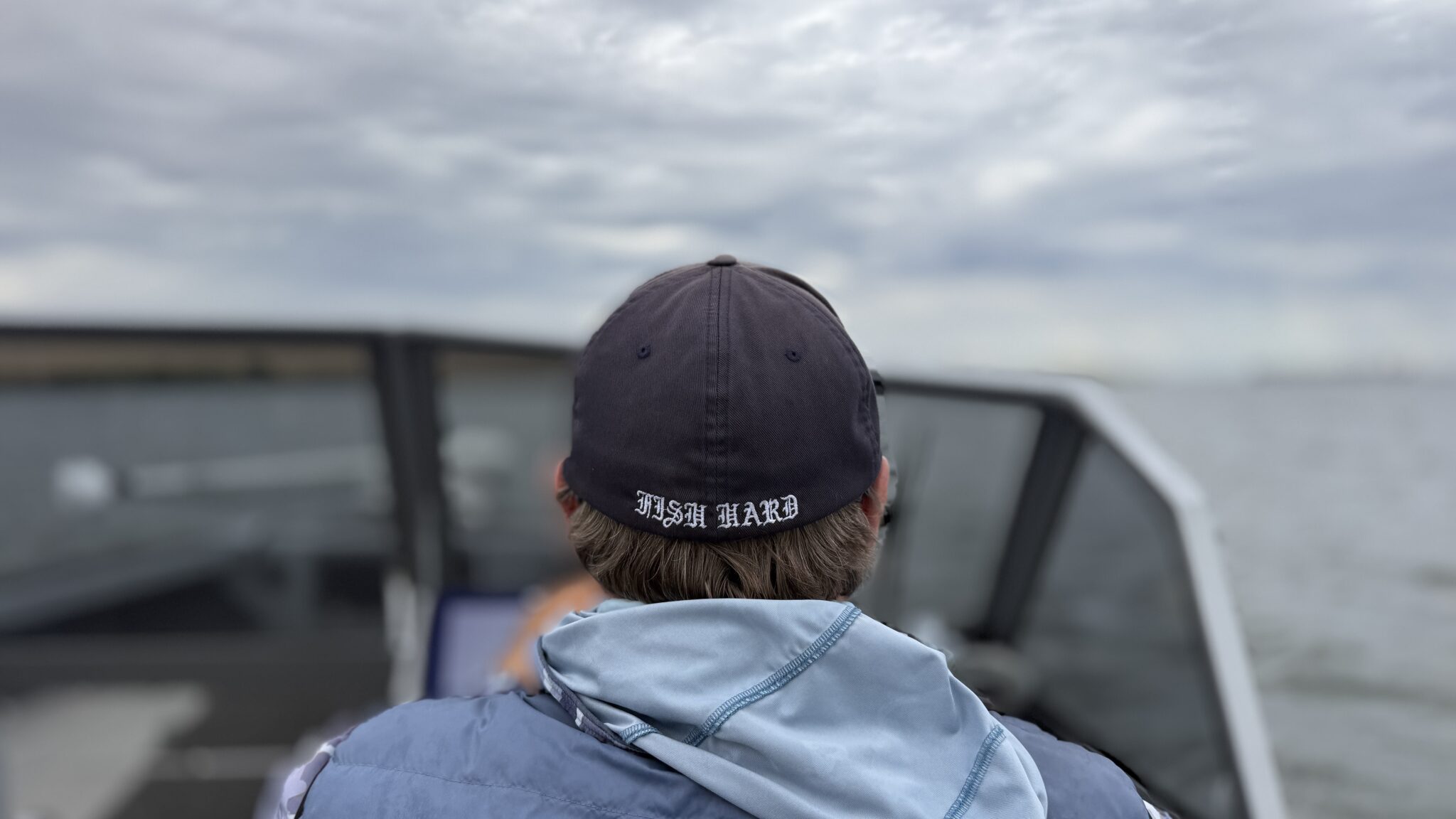
Last May was my first trip fishing the Delta with Richard and Mike, and it was so good that I was literally counting the days until I could do it again. That’s saying something, because I’ve fished all over the world since then. When I wrote about how fishing away makes the heart grow fonder for your local waters, I was really thinking about the Delta and fishing with Mike. Apparently you can fly halfway around the planet chasing exotic fish and still come home thinking, “Yeah, but when am I going back to Rio Vista?”
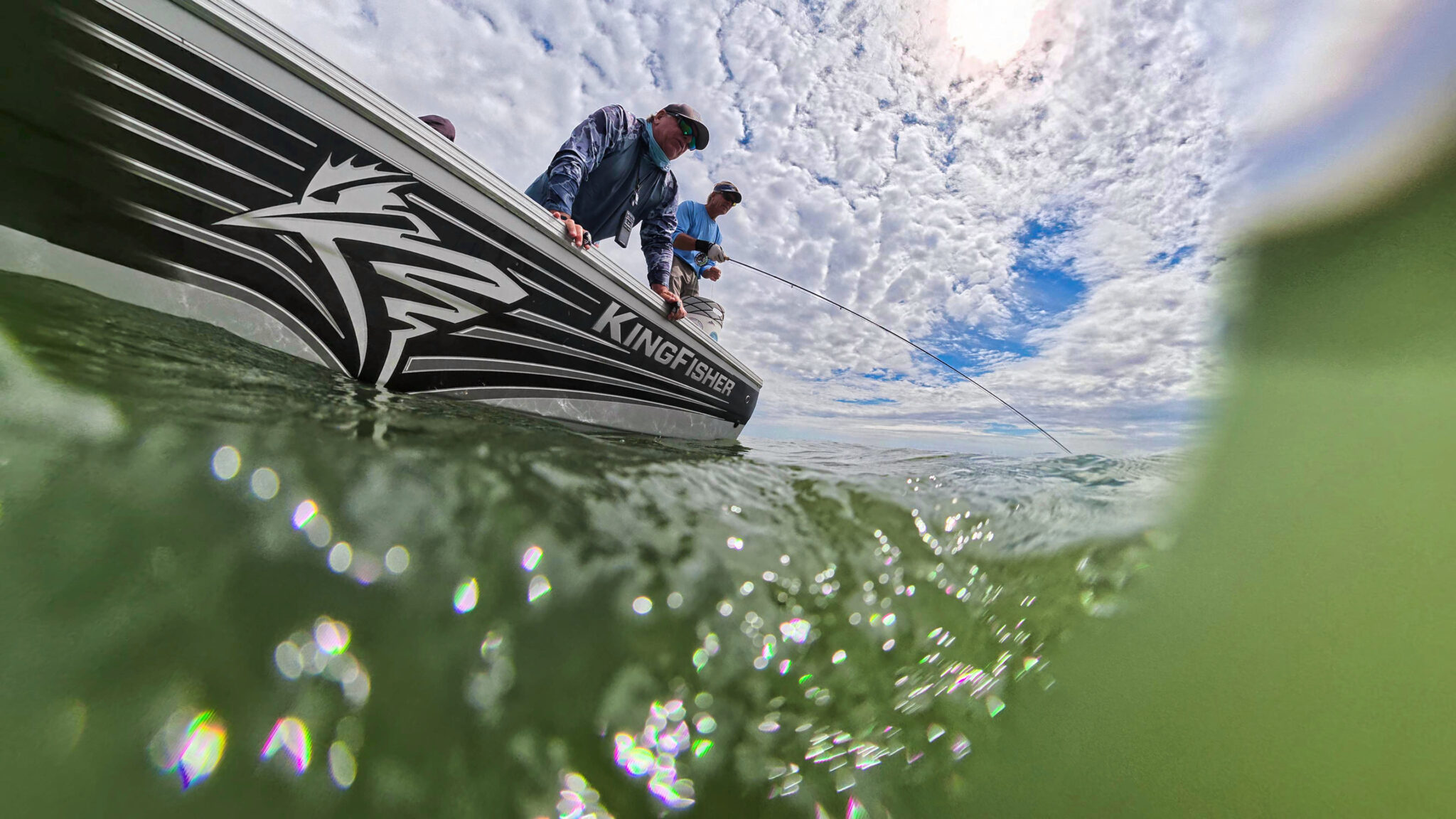
Conditions over these last two days were far from ideal. It was windy, cold and overcast pretty much the entire time—the kind of weather that makes you wonder whether August had been informed that it was supposed to be August. Last year Mike showed me a technique they use when the wind gets ugly: throw a straight backcast into the water behind you and load the forward cast off the water, almost like a Spey maneuver. It works amazingly well.
This weekend he taught me another cast for an even more annoying situation: wind blowing 90 degrees across your casting side. With an eight-foot rod and a weighted striper fly flying around your head, this isn’t merely inconvenient—it can become an unscheduled piercing. Essentially, Mike uses a continuous-load cast, transitioning from a low sidearm backcast into an overhead forward cast while keeping the rod loaded throughout the entire motion. I had never bothered learning it because I usually fish alone. If the wind is wrong, I simply move to the other end of my boat and put my casting arm downwind. Problem solved. When you’re on somebody else’s boat, apparently you’re expected to actually learn how to cast.
Both techniques are incredibly effective. I was getting around 70 feet directly into the wind with essentially one backcast. Even better, my rotator cuff has been giving me trouble since the tarpon trip, and this technique eliminated a lot of repetitive false casting. Hopefully that means the shoulder will be ready for the Sapsuk next week. Nothing says intelligent aging like resting an injured shoulder by preparing to catch several hundred silver salmon.
Fishing with Richard is always fun, and he’s becoming one of my favorite fishing buddies. There are several advantages to having younger fishing partners, starting with the obvious one: they’re younger. They’re also healthier, can lift things, and presumably will still be able to remember where we parked the truck. Plus, he is an incredible golfer and I can always count on him for some tips. Free golf lessons while fishing is a poer
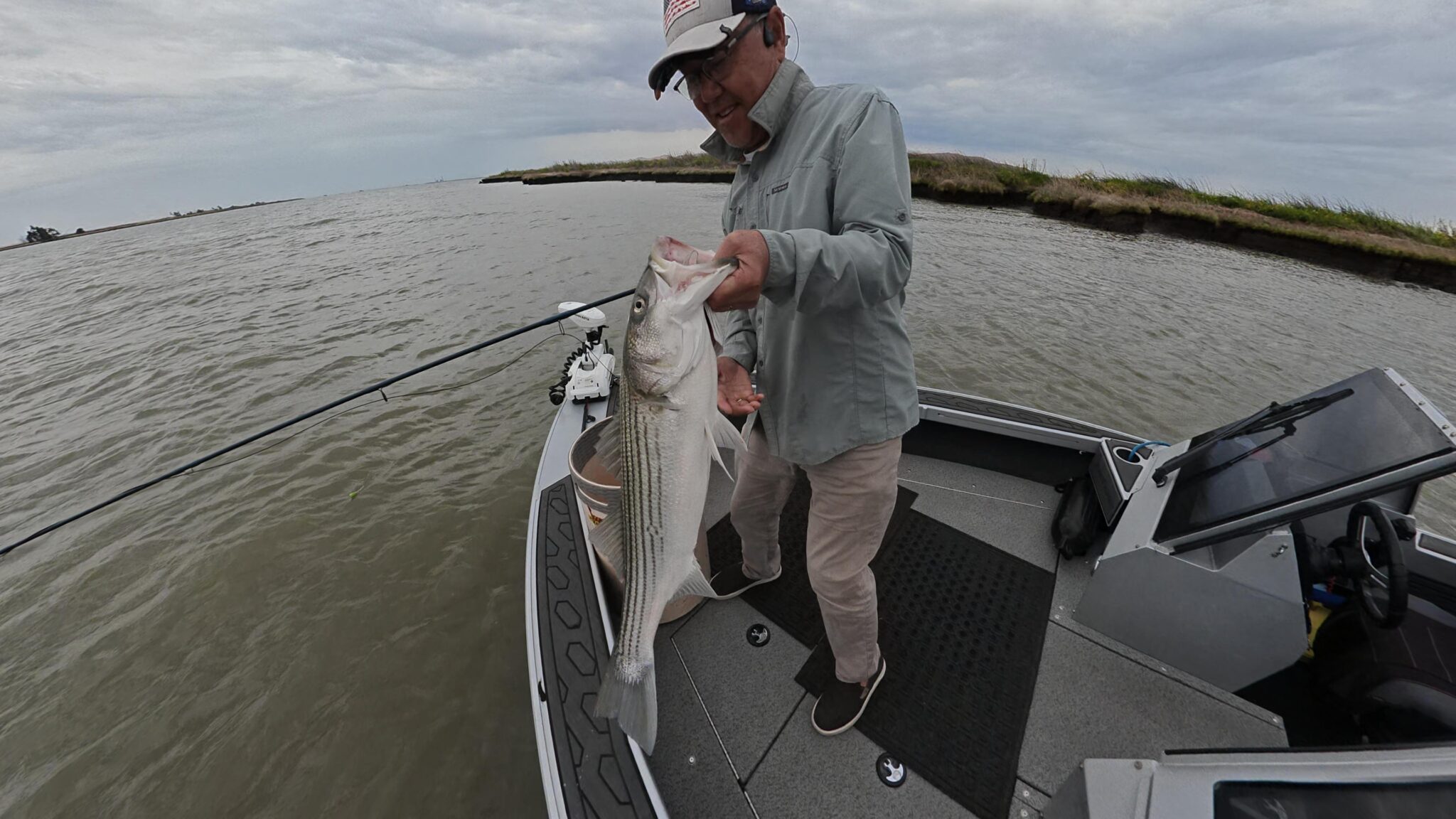
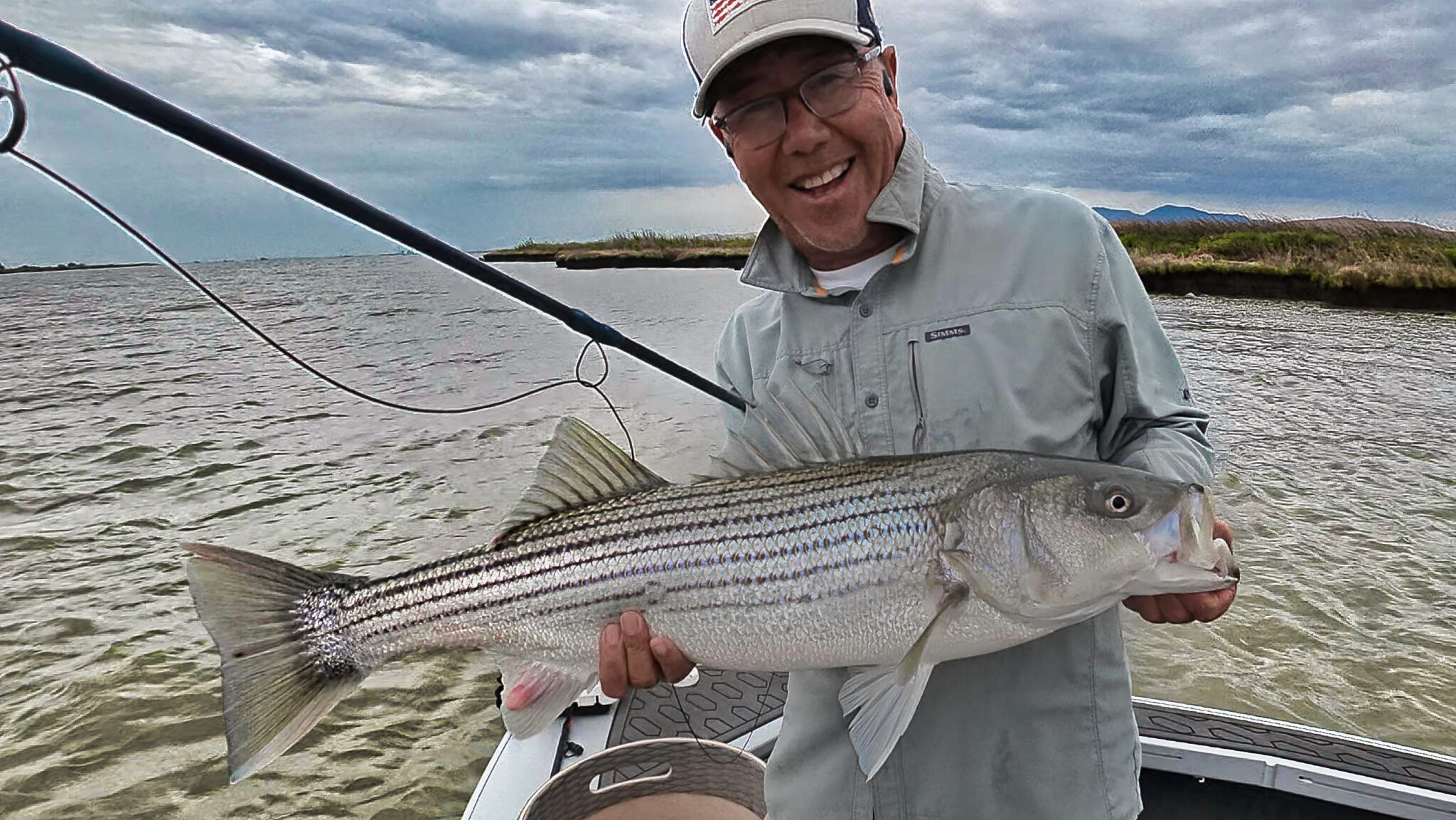
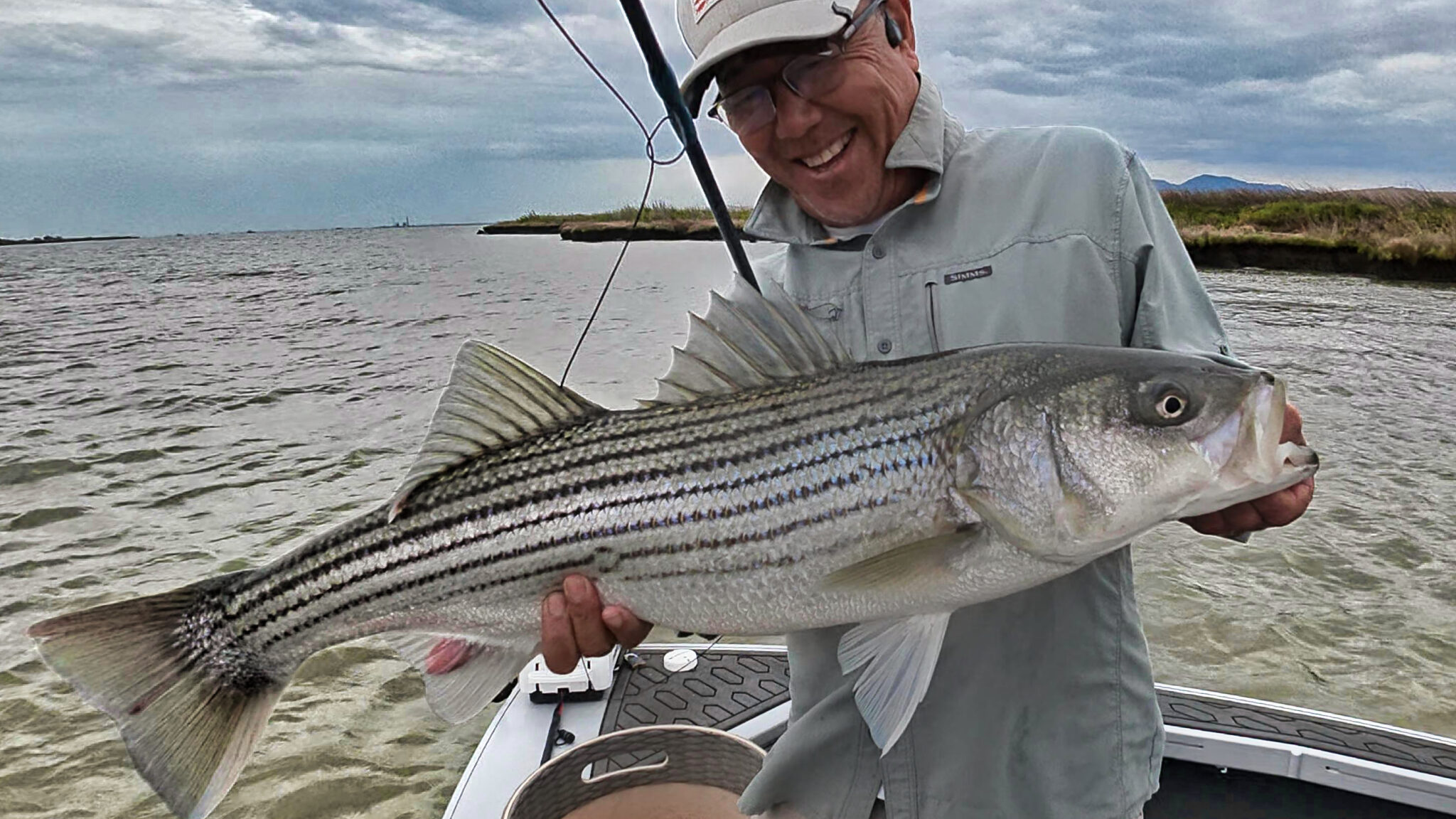
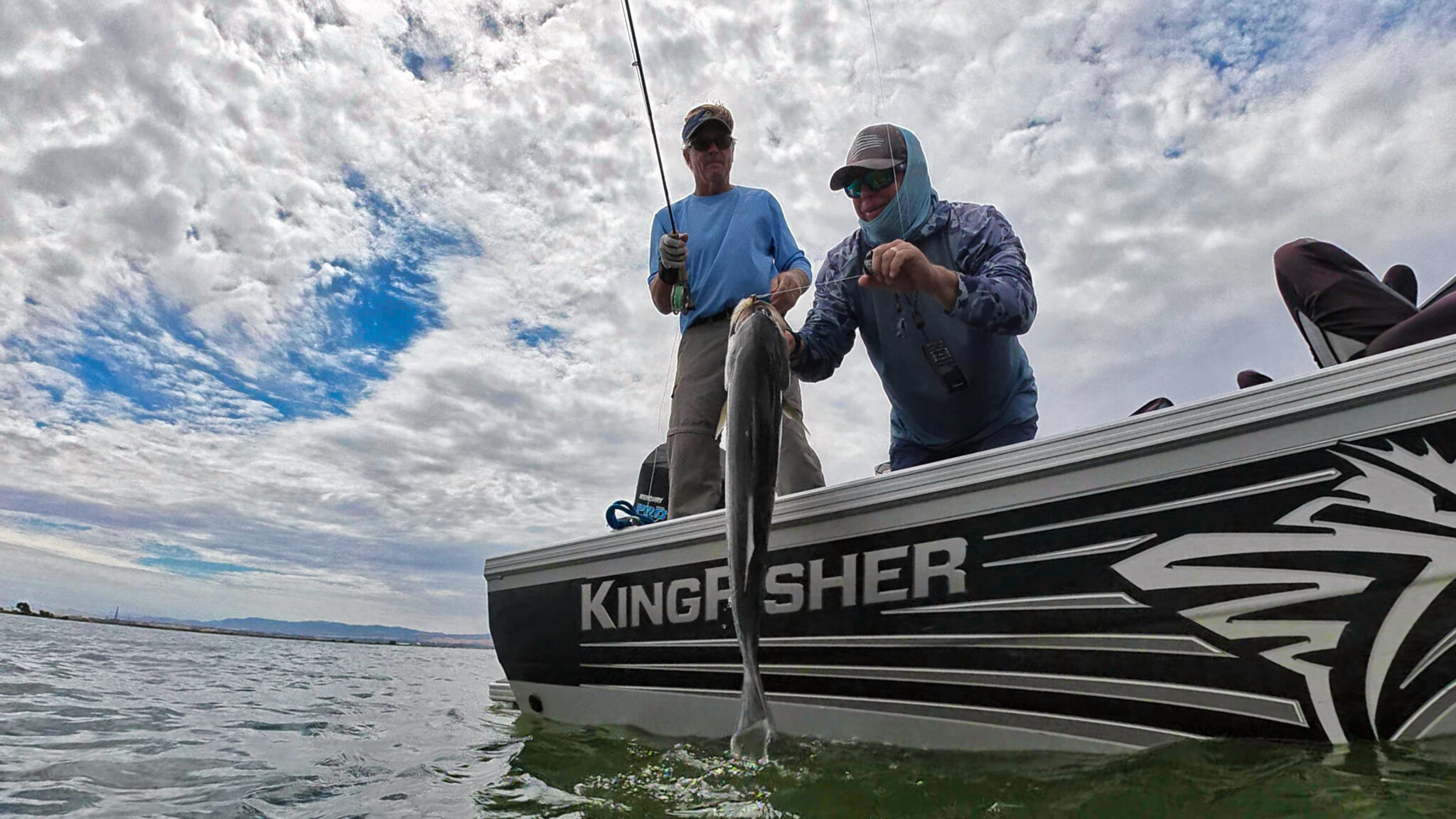
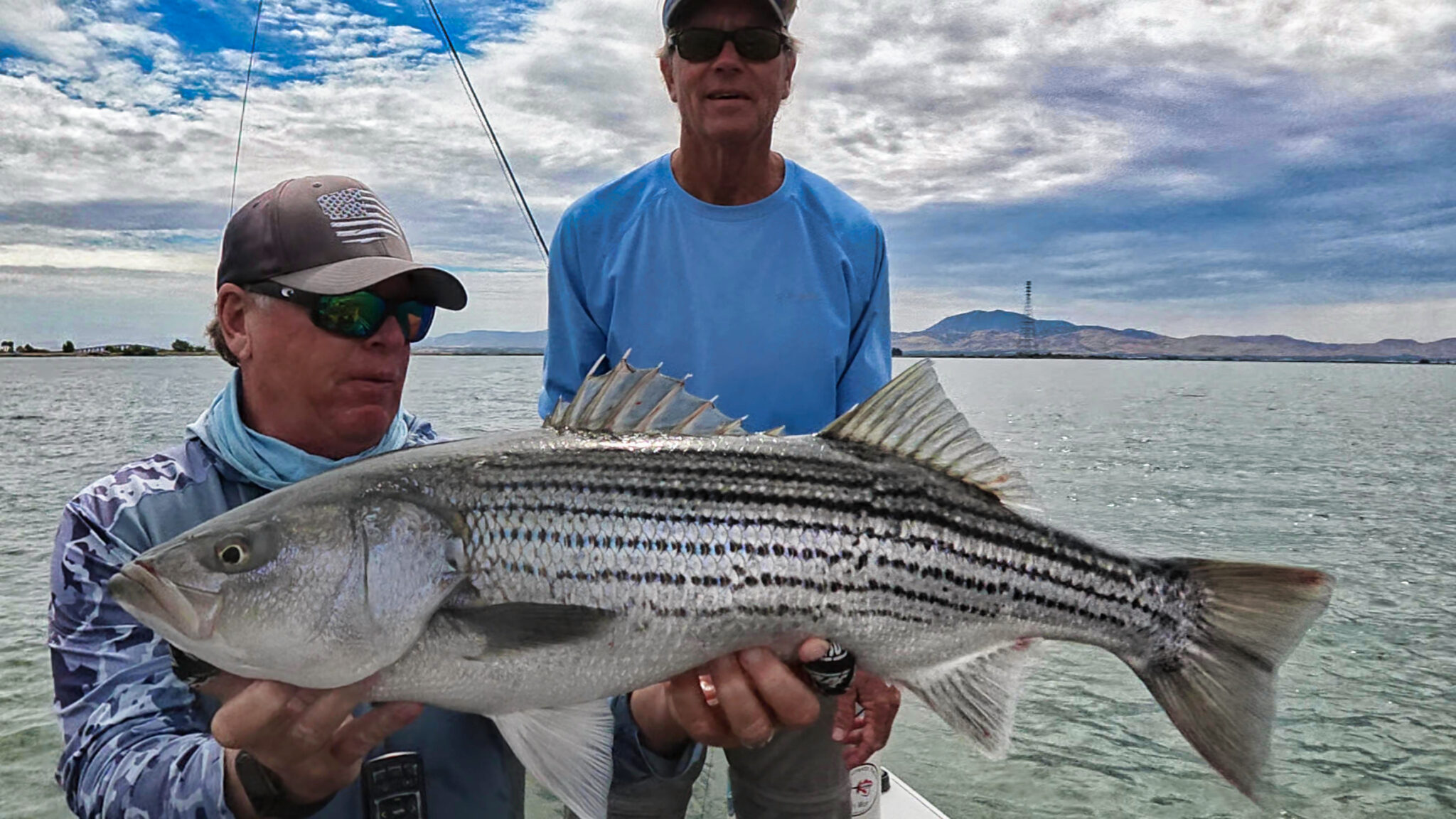
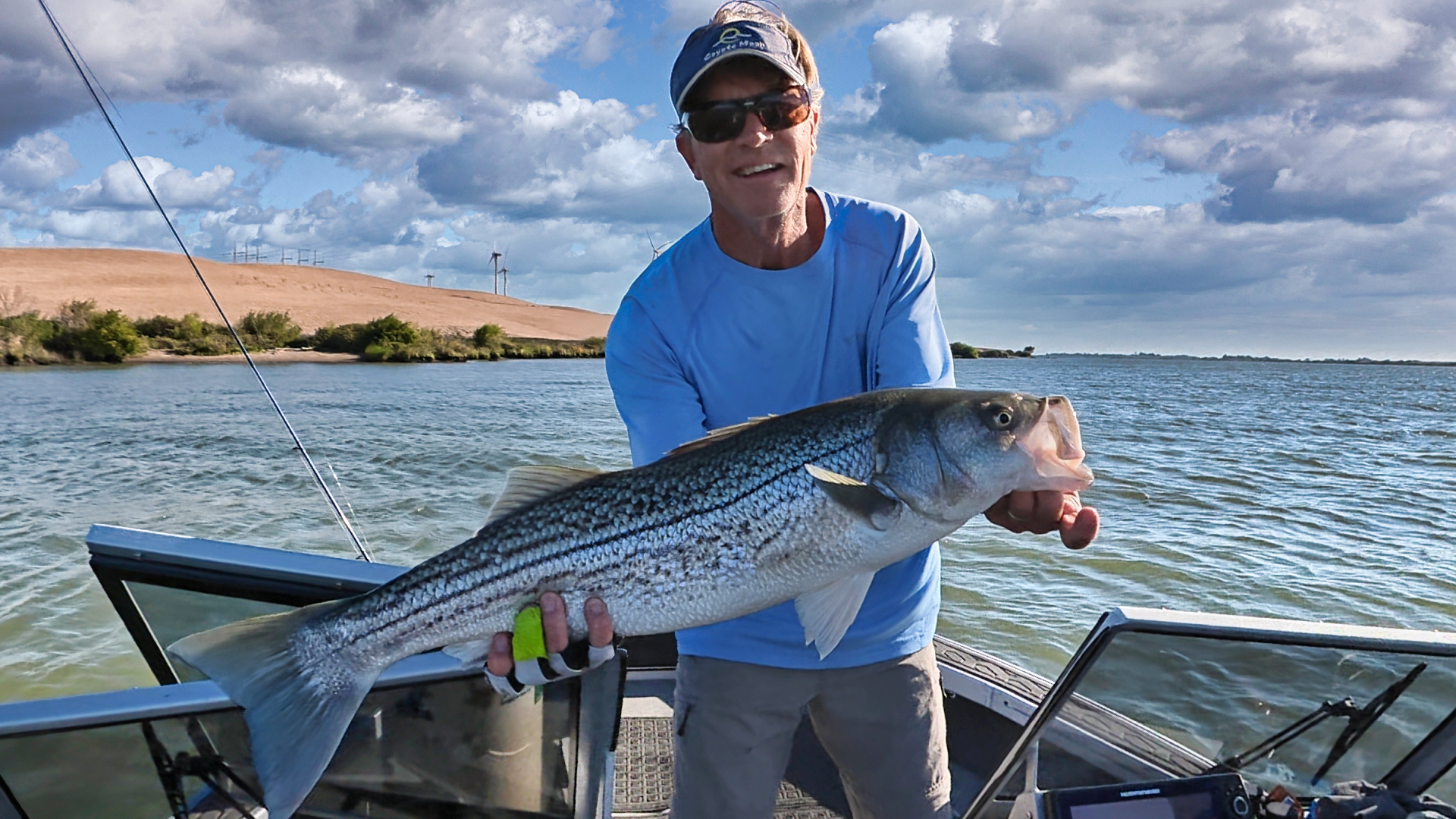
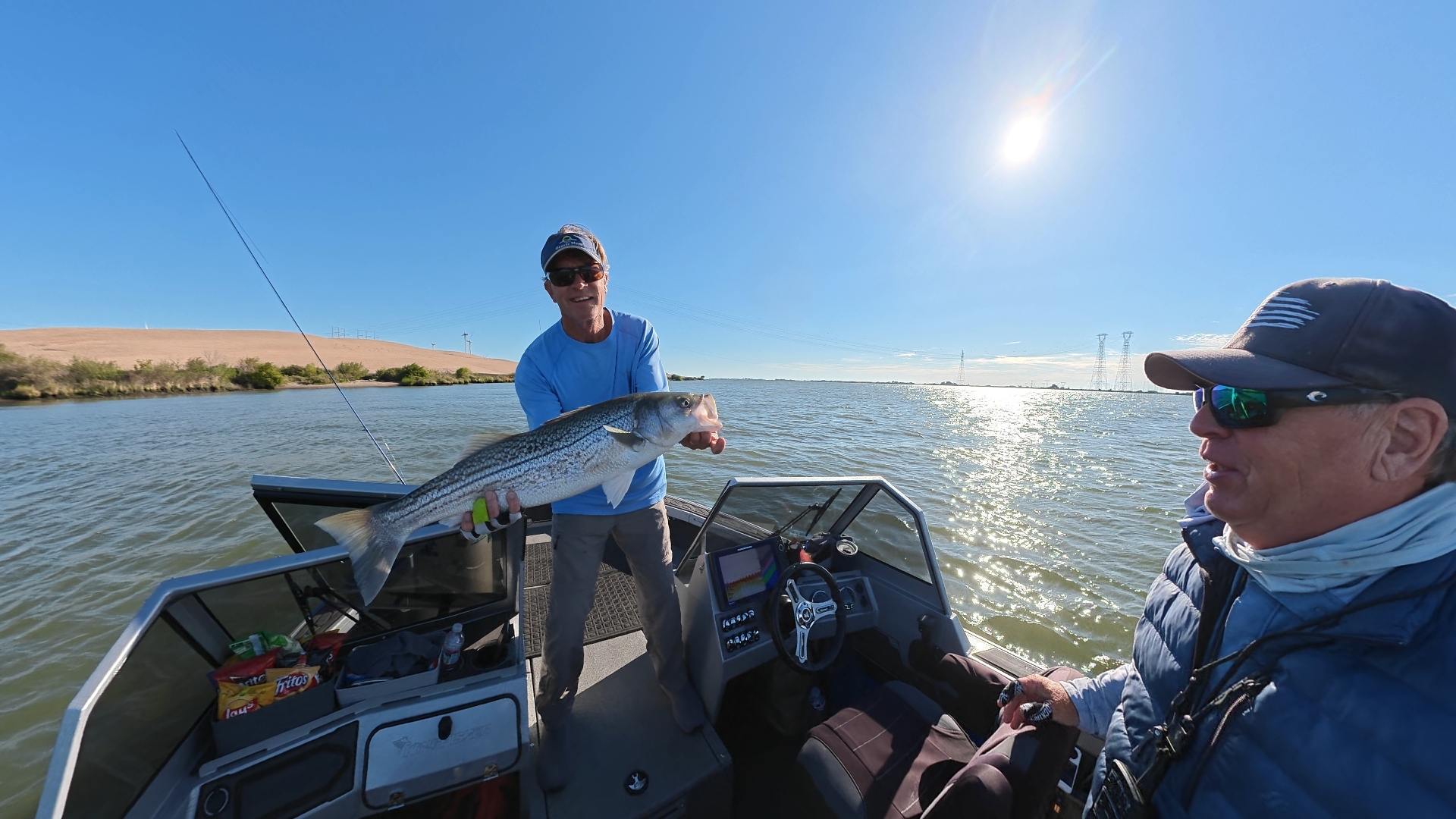
As usual when Richard and I fish together, it turned into a rip-lip festival. Richard knows how to catch stripers and actually hooked more fish than I did over the two days. Between us we landed more than 40 stripers. About 75 percent were over 20 inches, half a dozen were over eight pounds, and we landed three double-digit fish—two 12-pounders and a 13. Mike said it was the best August numbers for double-digit fish that he has recorded.
Still, the 20-plus-pound fish eluded us.
Again.
Somewhere in the Delta there is apparently a 20-pound striper carrying a copy of my calendar.
Considering the wind, cold and overcast conditions, though, we made the most of it. Forty-plus stripers with three double-digit fish isn’t exactly a tragedy.
When Good Tackle Goes Bad
The strangest part of the trip was the number of equipment failures Richard had while fighting big fish.
After fishing Mike’s equipment last May, I asked him if he minded if I brought my own stuff. Mike and I do a few things differently. He prefers mono leaders because he feels the stretch helps cushion that last surge from a 20-plus-pound striper at the boat. I prefer fluorocarbon. Neither approach is necessarily right or wrong—although obviously mine is right because this is my blog.
Mike also fishes almost exclusively with Steve Adachi’s Clouser Minnows. Steve ties awesome flies, and they’re favorites among a lot of veteran striper fishermen both in the Delta and in the surf. Mike’s custom versions are tied on Gamakatsu 594 60-degree flat-eye round-bend jig hooks, usually with a 26 mm plastic rattle.
The Gamakatsu 594 is a great hook. Today they’re roughly 50 cents apiece in smaller quantities, although pricing has become bizarre. I used to buy them in bulk for around 25 cents each. Now I’ve seen 100-piece “bulk” packages selling for roughly 75 cents per hook while a 25-pack works out to around 50 cents apiece.
Go figure.
Apparently somewhere along the way, “bulk discount” became “thank you for buying more; that’ll be extra.”
The 26 mm clear plastic rattles Mike uses can be found at fly-tying suppliers, but if you’re tying a lot of these flies, Alibaba and Temu are worth looking at. Search for 26 mm clear plastic fishing rattles and you’ll find them in bulk for roughly 5–10 cents each. There are plenty of arguments about plastic versus glass rattles. Glass generally produces a sharper acoustic signature, while plastic is lighter and considerably more forgiving when you’re repeatedly launching a big fly through the air. Whether stripers care about the difference is another discussion for another post.
All told, there’s probably only $2–$3 worth of material in one of these Clousers. Unfortunately, the fish don’t seem to know that. They treat them like jewelry.
Back to Richard’s equipment failures.
Over two days, Richard hooked four double-digit stripers that he lost because something failed.
The first was pretty clearly a knot failure. The leader came back with the signature little curly-Q at the break near the loop connection to the hook eye. That’s the classic fingerprint of a knot that tightened, deformed the leader and finally let go.
The second failure occurred right in the middle of the leader. That one was more mysterious. It could have been abrasion or possibly a wind knot, although I’d expect many knot-related failures to leave at least some deformation. This break was remarkably straight and clean.
The third failure occured where the loop attaches to the eye of the hook as if the rotating fly wore the leader out where it meets the eye. The failure looked like a Y in the line. Likely caused by the fly wearing out the mono after a lot of fish. Probably would not have happened with Flurocarbon.
Then came failure number four, which was the weird one.
A Gamakatsu 594 actually broke immediately behind the rattle, near the beginning of the hook bend.
That’s not something I expect from a 594. It’s a substantial hook, and none of these fish were being subjected to anything remotely approaching 20 pounds of pressure. My first thought was that perhaps the hook had somehow been damaged or distorted in a vise during tying, creating a weak spot in the metal. But that isn’t normally where you’d clamp the hook while installing a rattle, so even that explanation isn’t completely satisfying. It could simply have been an unusual defective hook.
Whatever caused it, seeing a Gamakatsu 594 snap on a double-digit striper gets your attention.
Mike’s equipment probably sees more big stripers—and more fishermen abusing it—than just about anybody’s. That’s the nature of guide equipment. Hundreds of fish, hundreds of casts, different anglers, different casting styles, flies bouncing around boats, leaders getting nicked, knots getting stressed and hooks getting reused. Mike said that the broken fly had caught hundereds of big stripers. I joked that an experation date on flies and leaders on guide boats would be a good idea.
The lesson isn’t that Mike’s equipment is bad. Quite the opposite. The lesson is that tackle is disposable but the fish of a lifetime isn’t.
Before fishing, run your fingers down the leader. Check every knot. Look for wind knots. Examine the fly. Check the hook. Especially when fishing with Mike who is a big fish, personal best, specialist.
Because your personal-best striper isn’t going to wait while you explain that the leader looked fine yesterday.
Rio Vista
What a cool little place Rio Vista is.
There’s something magnetic about that small-town Delta atmosphere with the marina right there. We ate at Lucy’s again, and the Thursday-night prime rib was every bit as good as I remembered. I keep telling myself that next time I’m going to explore more Rio Vista restaurants, but it’s difficult to conduct serious culinary research when Lucy’s keeps putting prime rib in front of me.
Richard also found a funky little motel in town that he plans to try next time instead of staying all the way over in Lodi. It’s called the Rio Sands Lodge, and the rooms have different themes. Word on the street is that Room 7 is the one to get.
Naturally, this now requires investigation.
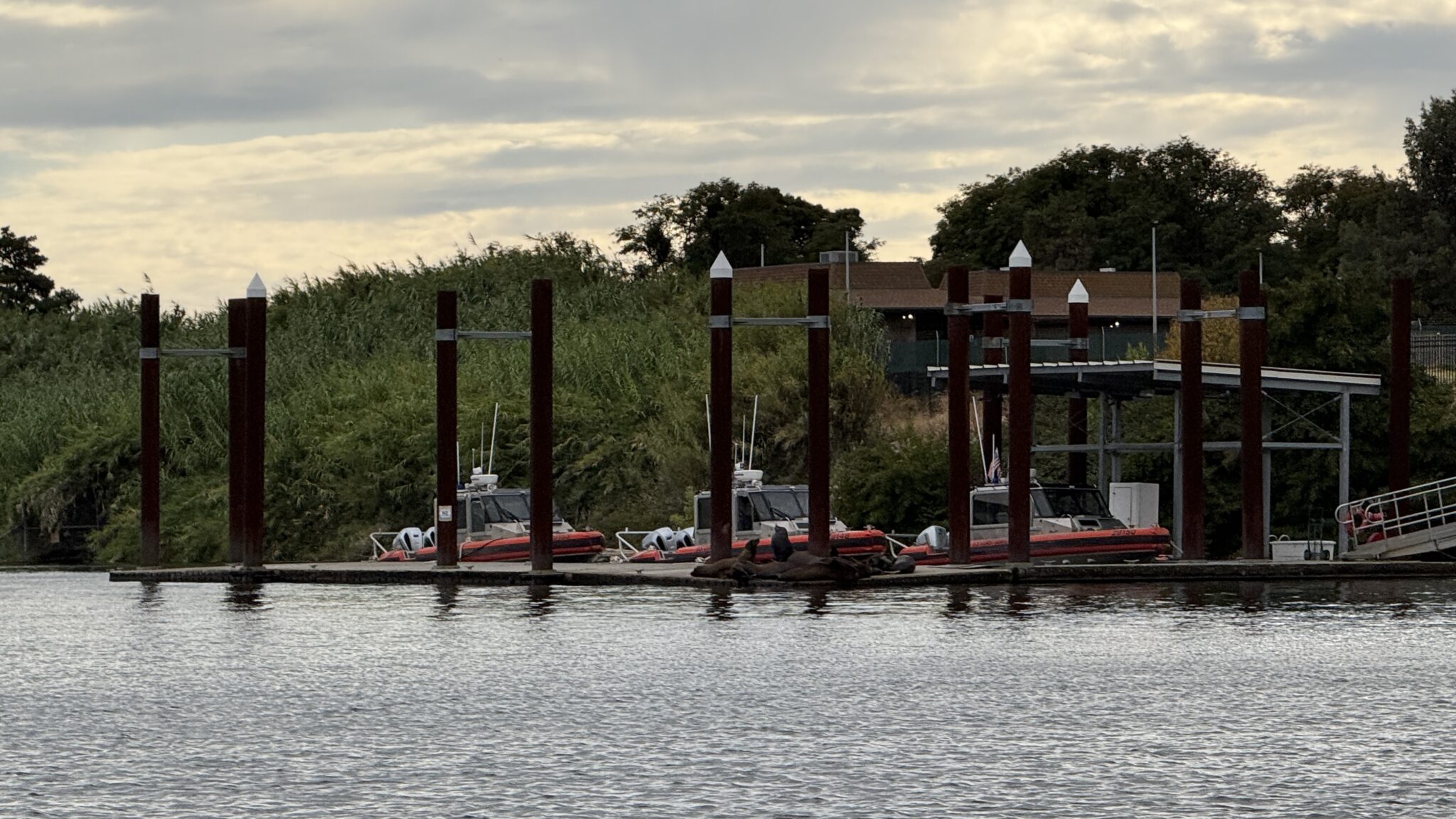
I also noticed several houseboats in Rio Vista where people actually live full-time. That got me thinking. Maybe a houseboat would be a better retirement option than buying a place on Bethel Island. Wake up, make coffee, step outside, get in the boat and go fishing.
There are worse retirement plans.
Although Gina may have some thoughts.
Maybe It’s Who’s in the Boat
I think we’re going to book about six days a year with Mike from here on out.
It sure beats dragging my own boat to the Delta, launching it, dealing with everything myself, fishing alone, pulling it out and towing it home. I’ve done plenty of that.
Maybe this is part of getting older. I’m finding myself caring a little less about how many fish we catch or exactly how big they are and a little more about who’s in the boat when we catch them.
Don’t misunderstand me. I still want the 20-pounder.
I’m not that old.
First Days With the New Insta360 X6
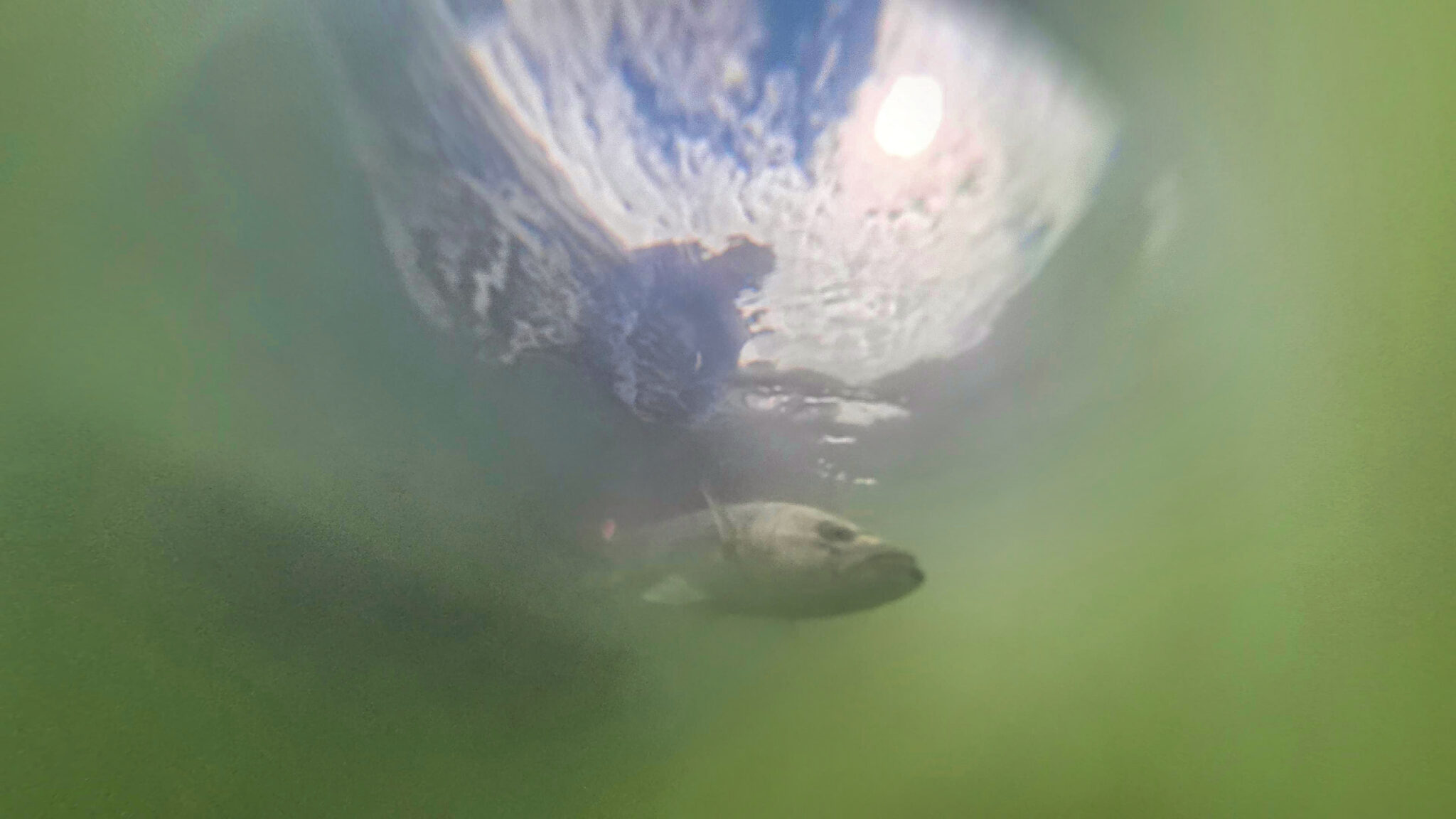
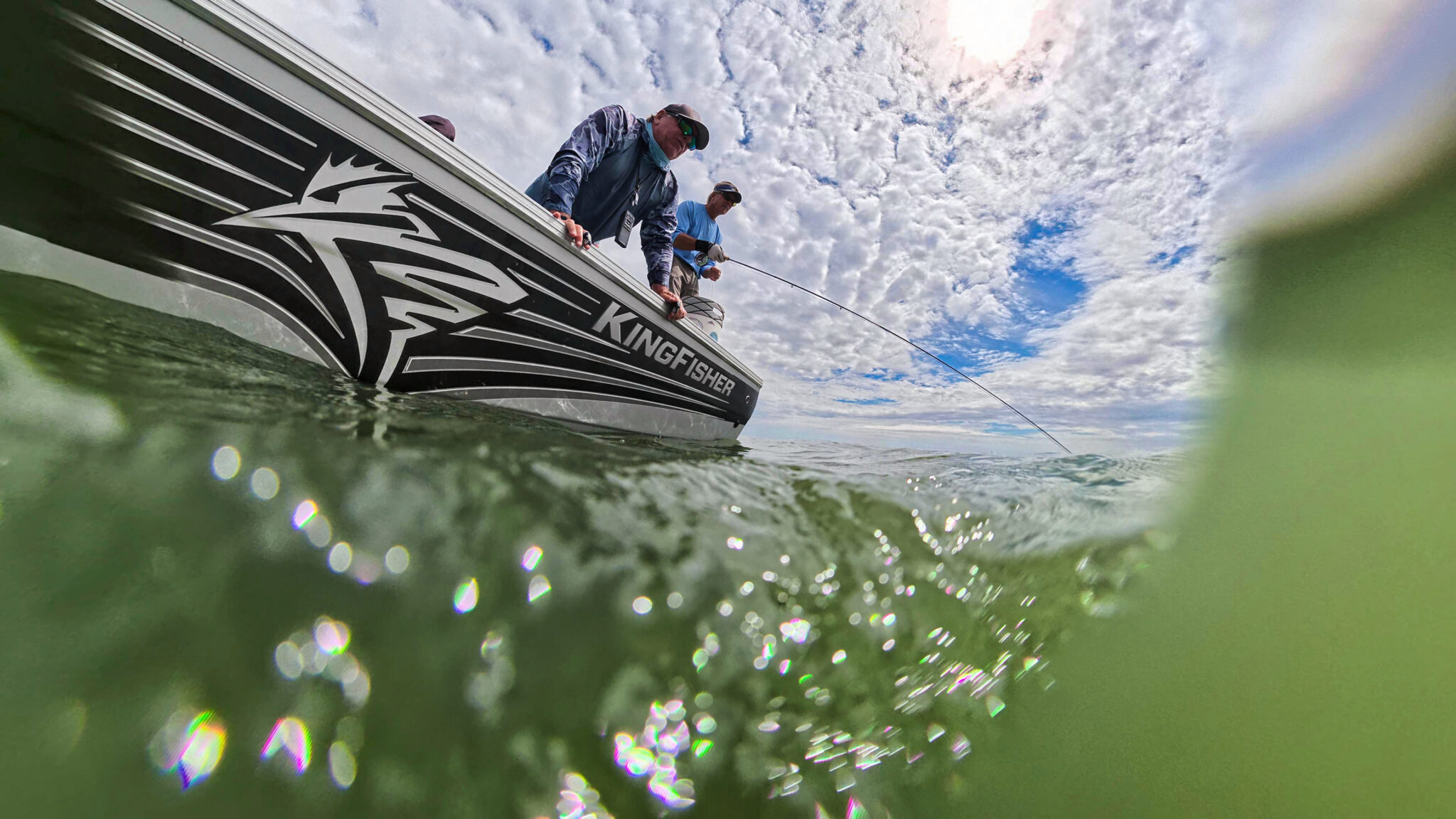
This trip was also my first real outing with the newly released Insta360 X6, and so far I’m impressed.
The X6 is a substantial upgrade over the X5, particularly for action, travel and outdoor photography. The larger sensors give you better detail, dynamic range and low-light performance, while higher-frame-rate 8K 360 video gives you considerably more flexibility when you’re trying to pull conventional photographs and video sequences out of a 360-degree capture.
But for fishing photography, the biggest advantage of a 360 camera hasn’t changed: you don’t have to know where the photograph is when you take it.
That’s huge.
When somebody suddenly hooks a big striper, nobody wants to stop the fight while I yell, “WAIT! MOVE THREE FEET TO YOUR LEFT! TURN THE FISH! RICHARD, LOOK AT ME! MIKE, MOVE YOUR ARM!”
With the X6, I can put the camera on a long telescoping pole or an eye-level mount, record everything around us, and decide where the camera was pointing later. In effect, you capture the moment first and compose the photograph afterward.
I used the X6 with my long telescoping poles and eye-level mounts to capture the stills from this trip, then massaged the final images in Luminar Neo and Photoshop. I’m pretty impressed with what came out of such a tiny camera. A few of these photographs look good enough to me that I think they could hold up at magazine-cover level.
That’s a pretty remarkable statement about a camera that essentially looks like a candy bar with two eyeballs.
Next week it goes with me to the Aleutians.
Cold weather, rain, salmon, boats, questionable decisions and fishermen who aren’t going to stop what they’re doing so I can compose a photograph.
In other words, a perfect test.


You forgot one break off. Thursday i had 3. The first one actually broke at the hook eye and came back looking like a “Y”.
The post is excellent as usual, thank you my friend. I so enjoy fishing with you for all I learn and see. I hope to have many more chances before i’m too old to go any longer.
I’m also very much looking forward to the video with music and lyrics by the soon to be new dynamic duo of Meng and Mike!
I edited the post to include that one. Also had lots of time on the plane to Alaska so I edited the films and posted a couple versions of Fish Hard. I havent heard from Mike yet but as soon as I do , Ill post his version when he has time to send it to me, As usualy , always fun with you. Lets go again soon.